 From
these we can construct a basic 'map' of each performers
tempos throughout the movement as follows:
From
these we can construct a basic 'map' of each performers
tempos throughout the movement as follows:
Emanuel Feuermann (1902-1942) was almost universally recognized during his brief lifetime as a peerless master of the instrument. Artur Rubinstein said "Feuermann became for me the greatest cellist of all time"[1], Jascha Heifetz accepted him as the first cellist worthy of serious collaboration, and would not play with another for nine years after his death. He was the cellist of choice for conductors including Toscanini, who described him as "the greatest" and said that "there is no one after him"[2] and Szell, who said that he played with "...noblesse and distinction, and with the complete equipment in the service of an artistic purpose."[3] His premature death during routine surgery in 1942 at the age of 39 brought his career to an end before he had a chance to establish the type of widespread fame that Heifetz and Casals secured, but even today -more than half a century after his death- there is a clear consensus, among cellists who were privileged to hear Emanuel Feuermann play and among those familiar with his recordings, that Feuermann was a cellist without equal. His graceful, elegant playing shows both a warm, Kreislerian musicality and a fluid and facile command of the instrument that most cellists agree has never been approached since.
Despite his revolutionary style of playing, Feuermann had a surprisingly limited impact on the generations of cellists that followed. Before coming to America in 1937, Feuermann’s active performing career prevented him from teaching widely. After relocating to America, where he was less well known and concerts were more scarce, he became more active as a teacher, eventually becoming associated with the Curtis Institute. Although he taught many students for short periods of time, his notoriously difficult and demanding lessons and his premature death prevented him from developing a group of students well versed in his craft, as Casals and Piatigorsky did, that could relay his musical and technical ideas to future generations. While there are many cellists today who have studied with Feuermann, at least briefly, there are few who count him as the main source of their cellistic knowledge and perhaps none who represent his technical and stylistic abilities in performance.
Is it possible that Feuermann’s abilities on the instrument were unique to him - a ‘god given talent’ that could not be imitated merely by studying at the feet of the master? Surely there is some aspect of this in Feuermann’s playing. No one would expect to be able to replicate his abilities merely by understanding the underlying principles. But Feuermann himself believed that cello playing of his day was victimized by poorly thought out technical habits and illogical approaches to achieving musical effects. He planned to lay out his technical philosophy in a book begun shortly before his death. Unfortunately, only a few pages were completed (Reprinted in appendix I). If Feuermann, who was keenly aware of his talent and also of what could be taught and absorbed by his students, believed that his technical ideas were indeed revolutionary and duplicable, there seems no reason to doubt him. It is curious that so many modern cellists pay lip service to Feuermann as the greatest cellist of all time and yet make little attempt to understand the fundamentals underlying his playing.
The neglect of Feuermann's legacy may be due in part to the lack of available information. Feuermann’s relative obscurity among non-cellists, stemming from his early death, has led to an unfortunate lack of published material regarding his life and teachings. To date, only one biography has been written, by Seymour Itzkoff (Emanuel Feuermann, Virtuoso 2nd ed. Schweinfurt, Germany: Reimund-Maier-Verlag, 1995), which is somewhat inadequate, and a second, by Annette Morreau, is currently in progress. The only other major published source of information about Feuermann is a memorial issue of The Strad (April 1988, Vol. #99) containing articles, interviews, a discography and related items. The discussion of technique in all these sources (aside from Feuermann’s own few pages) is at best anecdotal and is largely ignored. The question which motivated the creation of this document was, in the absence of Feuermann's planned treatise on technique, how to gain insight into his methods?
Several different approaches were pursued.
The second chapter contains a detailed analysis of Feuermann's two commercially available recordings of the Dvorak concerto. They are contrasted with Dvorak recordings of Casals, Piatigorsky, Rostropovich and Yo-Yo Ma, not an attempt to make any judgment as to which are 'better' or 'worse', but in order to better understand the specific differences that define Feuermann's playing. The choice of these four cellists for comparison might be debatable, but it was not possible to include every important cellist of the century, and these four represent a very broad spectrum of musical and technical approaches and are the best known and, arguably, the most influential cellists of this century.
The third chapter examines one of Feuermann's three published performing editions in detail-the Schumann concerto and -again for the sake of illuminating what was unique to Feuermann- contrasts it to three other well known performing editions of the same concerto made by Joachim Stutschewsky, Leonard Rose and Heinrich Schiff. The details of Feuermann's choices of fingerings and bowings are observed and contrasted with those of the other three performers.
The fourth chapter is an analysis of the physical aspects of Feuermann's technique as observed in the one known existing film of him performing. Again, to establish clearly what is different or unusual with his technique, observations are compared to those taken from filmed or videotaped performances of Casals, Piatigorsky, Rostropovich and Ma. General physical attributes such as body position, and cello height and placement are discussed in addition to detailed analysis of the mechanisms of the bow hand and arm and those of the left hand, fingers and arm.
Interviews with five surviving Feuermann students and his sister Sophie, who served as his accompanist for many years, make up the final section of the document. The interviews focus on technical and musical issues, but some seemingly extraneous detail is also included, as the insight it provides into Feuermann's character and life seems important and meaningful, even if not directly related to the topic.
The first appendix is Feuermann's own writing on cello playing and teaching, which is vitally important to the focus of this paper and should almost be read prior to the body of the work. Its placement as an appendix only represents the fact that it is not original to this document. The essay is reprinted from Seymour Itkoff's biography. The second appendix contains the cello parts to Feuermann's three performing editions: The Boccherini A Major Sonata, the Schumann Concerto and the Mozart concerto, originally K.314, transcribed for Feuermann by George Szell. These cello parts are reprinted with the gracious permission of G. Schirmer and Carl Fischer, Inc.
The goal of this research was to discover as many details of Feuermann's musical and physical techniques as possible and provide for all interested cellists a better understanding of how it was that he played. I grew up listening to Feuermann's recordings-there are recordings in which I have memorized every minute detail, recordings which I have heard literally hundreds of times. And yet as familiar as I was with Feuermann's playing as a listener, I discovered throughout the course of my analysis how little of Feuermann's style and methods I had been able to understand or absorb merely by appreciating his recordings. The understanding I gained developing this document has changed my understanding of Feuermann's playing and the way I play the cello forever, and it is my sincere hope that it can do the same for other interested cellists. Not that we should attempt merely to imitate Feuermann, but that we may understand the underlying principles of his technique and musicianship, in order to develop the art of cello playing to the potential that Feuermann showed it could have.
For those unfamiliar with Feuermann's life, we begin with a brief biography:
Emanuel Feuermann was born on November 22, 1902 in the town of Kolomea, in what is now the Ukraine, but at the time was part of the Austro-Hungarian empire. Born into a musical family, his father, Maier Feuermann performed and taught locally on both the violin and cello. Emanuel, or 'Munio' as he was called [4], was the third of five Feuermann children. His older brother, Sigmund achieved much notoriety as a violin prodigy, overshadowing Munio in the early part of his life. In order to further Sigmund's progress and career, the family moved to Vienna in 1908, where Sigmund eventually studied with Sevcik, and Maier played in the Tonkünstler Orchestra. Munio's earliest cello studies were sporadic, with his father as teacher. He did not begin to study regularly until he was seven years old. He later began studying privately with Anton Walter and made quick progress. He performed his first recital in late 1913 in Leopoldstadt, made his first orchestra appearance shortly afterwards with the Tonkünstler Orchestra, playing the Haydn D Major Concerto. Although sources are unclear, there are some accounts that he made his official debut with the Vienna Philharmonic in February 1914, with Felix Weingartner conducting, again playing the Haydn concerto. The Philharmonic concert was reputed to have been a critical success and the young Feuermann toured with Sigmund during the next three years, performing the Brahms Double Concerto.
In 1917, at the age of 15, Munio was sent to Leipzig to study with Julius Klengel, where he remained for the next two years. When Friedrich Grützmacher died suddenly, leaving the cello professorship at the Gürzenich Conservatory in Cologne vacant, Klengel was asked to suggest a possible successor, and he nominated the young Feuermann, who began his professorship there in the fall of 1919, still only sixteen years old. In addition to his teaching duties, he served as cellist for the Gürzenich quartet and first cellist of the Gürzenich orchestra. During the following years, Feuermann began to perform throughout Europe with increasing frequency, and made his first commercial recordings (the second and third movements of the Haydn D Major Concerto) in December, 1921. In 1923, Feuermann resigned his post in Cologne in order to devote his full attention to his active concert career. During this period he collaborated with Bruno Walter and George Szell, as pianists, and Artur Schnabel and Carl Flesch, among others. In the Fall of 1929, Feuermann was appointed to the cello professorship at the Berlin Hochschule für Musik, the premier teaching position in Germany, and he maintained this post while continuing an active concert and recording career. He also formed a string trio with Paul Hindemith and Joseph Wolfsthal, who was replaced after his tragic death by Szymon Goldberg. Hitler's rise to power led to Feuermann being relieved of his post at the Hochschule in 1933.
Fleeing Nazi persecution, Feuermann stayed briefly in Paris and then in London. He moved to Zürich in 1937 and finally to America, where he arrived in October of 1938. During these years, Feuermann continued to record and perform and made several world tours, increasing his reputation. He made his American debut with the New York Philharmonic on January 2nd, 1935 and followed this with a Town Hall recital twelve days later, achieving a great critical success. His collaborations by now included almost all of the major orchestras, and he finally achieved much sought after success in England with his performance of Strauss Don Quixote with the BBC Symphony and Toscanini, who had insisted on Feuermann as soloist, in May of 1938.
Feuermann continued to perform after moving to America, but most of Europe was soon unavailable for concertizing because of the war. He collaborated in chamber music performances and recordings with Heifetz, Primrose and Rubinstein. Feuermann lived in New York, settling eventually in Rye, and taught both privately and at the Curtis Institute. On May 25th, 1942, at the age of thirty nine, he died following routine surgery, probably from complications resulting from an allergic reaction to morphine.
Many feel that towards the end of his life, Feuermann's playing had reached a level higher than even he had previously attained. We can only wonder what might have followed, had his life not been cut so tragically short. Feuermann left behind a legacy of over 70 recorded works that provide compelling evidence that his level of musical and technical mastery is unequaled, before or since.
_______________________
1 “As they Knew Him,” The Strad, 99 (April 1988): 314
2 Seymour Itzkoff, Emanuel Feuermann, Virtuoso, 2nd ed., p. 213 (Schweinfurt Germany: Reimund-Maier-Verlag, 1995)
3 3 “As they Knew Him,” The Strad, 99 (April 1988): 314
4 For a discussion of the origin of the names “Munio” and “Emanuel” see the Sophie Feuermann interview on p. 143.
INTRODUCTION
The most direct and obvious evidence of Feuermann's playing comes from the recordings which he left. No other evidence could relay as clearly his style and abilities as a cellist. The goal of this analysis is a comparison of all aspects of Feuermann's playing -including tempos, use of glissandi, vibrato, 'timing' for musical effect, the use of accents and other forms of emphasis, and specific phrasing at fixed points- to those of the other four most famous and influential cellists of this century, Casals, Piatigorsky, Rostropovich and Yo-Yo Ma. The intention is to record only what is clearly observable, i.e. that X produces a slower vibrato than Y, or that Z makes a large ritard in a certain measure, and in this way come to a better understanding of what made Feuermann unique, without raising the argument of what is 'good' or 'beautiful' versus what is not. Reviews of recordings tend to focus on what the reviewer finds either compelling or distasteful. Although not conceding the view that all of what is aesthetically beautiful in music is 'relative' to the tastes of the listener, this is not a forum for that argument.
All of us, when we listen to music performed, form an opinion as to whether it is beautifully rendered or not. Professionally trained musicians form their opinions with a background of many years of interpretation, performance and analysis, allowing them more insight into the mechanisms of performance and interpretation with which to make their judgment. Still, it is shocking to realize how few of the thousands of minute details that together comprise an interpretation are never consciously comprehended.
To take the example of a cellist. There are only a few factors which a cellist may control in producing any given note: from the right hand -bow speed, bow pressure, the placement of the bow between the bridge and fingerboard, and the angle of the bow, which controls how much hair comes in contact with the string- and, from the left hand, vibrato - both width and speed. Furthermore, between notes, by controlling the coordination of the two hands, he can control the timing between the notes and he can control whether any glissando and what type is made between notes (In addition, if the coordination is not precise and the left hand does not stop the string completely, noise can also be produced, but this is not intentional.) This is the sum total of all the physical variables that we can control and from which we must create everything that happens musically on the cello.
In musical terms this means that on one note we can control the length, various types of accent or emphasis ( >, — ), diminuendo or crescendo during the course of the note, vibrato, general dynamic and the type of sound. Between notes we also control the length of time until the next note sounds -allowing us to establish a feeling of tempo, accelerando and ritard over the course of a several notes- the dynamic relative to the previous note -allowing us to establish a sense of crescendo or decrescendo- and glissandi. Over the course of a phrase, these simple variables combine together, on and between each note, to create all the nuances we describe as 'phrasing' . The complexity and density of these nuances is greater even than that found in speech. Herein lies a factor in music's powerful communicative ability perhaps, but also a situation that is very difficult to break down in analysis without becoming hopelessly lost in minor details.
The intention of this chapter is to provide a comparison of the playing of these five cellists, not in the sense of what is good and what is 'bad' or who is 'better', but only of what is clearly recognizably different in their approach, specifically, in their recordings of the Dvorak concerto. While this restriction might seem to create an artificially limited comparison, the patterns noted here can be seen throughout the recorded works of these artists. The Dvorak merely provides a convenient point of reference. Some generalizations can be made from the recordings as a whole, but for other factors it is necessary to compare very specific points, in order to be able to truly understand the details of each performance. It is striking how many of these details the listener, even a trained musician, is unaware of during casual listening. One gets a general impression from the sum total of these effects, but unless truly trained to be aware of them, one is never really clear as to how that general impression is formed. It is similar to listening to spoken dialogue, where we are aware of the meaning the speaker conveys by inflecting a sentence without being aware of the mechanisms of the many subtle articulatory gestures that combine to convey that meaning.
To those who find this an overly technical treatment of what is essentially an inspirational art, consider that Form was developed to describe what was the result of inspiration to the composers, and so we also must find a way to understand and discuss musical performance if we truly wish to understand and improve our art . We should not be satisfied to say 'This is beautiful ' or 'This is not' without making an effort to understand what specifically we are reacting to.
For this comparison, six recordings were used; two versions of Feuermann, one recorded commercially and one taken from a live performance, and one each of Casals, Piatigorsky, Rostropovich and Yo-Yo Ma. These performers were selected because they are the best known cellists of this century and have had the most widespread influence as performers. The details of these recordings are as follows:
Cellist Conductor Orchestra Year Age
Feuermann Michael Taube Berlin State Opera House 1928-29 [1] 25-26
Casals George Szell Czech Philharmonic 1937 60
Feuermann Leon Barzin National Orchestral Assoc. 1940 (Live) 37
Piatigorsky Charles Munch Boston Symphony 1960 56
Rostropovich Seiji Ozawa Boston Symphony 1985 58
Ma Lorin Maazel Berlin Philharmonic 1986 30
TIMINGS
The first striking feature one notes in comparing these recordings is the wide range of timings for the recordings. While this might seem to be unimportant at first, these timings are the result of the performers tempos and use of rubato and, while small differences may be insignificant, huge variations cannot be ignored. The variation from the shortest recording, the 1928-29 Feuermann version at 32'49", to the longest, Yo-Yo Ma at 42'08" is stunning. The Ma version runs almost ten minutes longer, almost a third again the length of the Feuermann version. The others fall in between, with Casals at 35'31", Feuermann live also at 35'31", Rostropovich at 38'58" and Piatigorsky at 41'55".
Some might further argue that timings are irrelevant to an analysis of the performers' playing, due to the influence of the conductor and the sizable tuttis, but a clear and direct correlation between the performers' chosen tempos and their overall timings was found, as will be seen in the next section. While avoiding an argument about whether it is better to play either faster or slower, a comparison of the Casals and Feuermann tempos and timings to those of the later performers illuminates a clear difference in approach.
The differences in these five recordings raise a broader question as to whether these recordings might be an indication of a wider trend. While it was not feasible to compare the specific tempos of each performer on every available recording of the Dvorak, it is a fairly simple matter to check the timings for each movement, which correlate fairly consistently and meaningfully with the performers choice of tempos. The following is a list of commercial recordings with timings, put in chronological order by recording date. Unfortunately, there are very few recordings dating from before 1960, besides the aforementioned Casals and Feuermann, so any generalizations about trends over time must assume them to be representative of their respective generations.
Performer Conductor Orchestra Mvts Total Year
Feuermann Taube Berlin State Opera House 11'58" 32'49" 1928-29
10'22"
10'29"
Casals Szell Czech Philharmonic 13'27" 35'31"
1937
10'28"
11'36"
Feuermann Barzin National Orch. Assoc. 13'09" 35'31"
1940
11'46"
10'36"
Piatigorsky Munch Boston Symphony 15'45" 41'55"
1960
13'11"
12'59"
Fournier Szell Berlin Philharmonic 14'44" 38'26"
1962
11'23"
12'19"
Starker Dorati London Symphony 15'08" 38'06" 1962
11'11"
11'47"
Performer Conductor Orchestra Mvts Total Year
Rose Ormandy Philadelphia Orchestra 14'54" 38'48"
1963
11'37"
12'17"
Gendron Haitink London Philharmonic 14'33" 39'12"
1967
11'50"
12'49"
Rostropovich Karajan Berlin Philharmonic 15'42" 41'21"
1968
12'41"
12'58"
Du Pré Barenboim Chicago Symphony 15'19" 42'00"
1971
13'12"
13'29"
Nelsova Susskind St. Louis Symphony 14'08" 36'49"
1975
10'30"
12'03"
Harell Levine London Symphony 14'50" 41'59" 1975
13'43"
13'26"
Rostropovich Giulini London Philharmonic 16'28" 43'06"
1978
12'56"
13'42"
Tortelier Previn London Symphony 15'20" 39'19"
1979
11'38"
12'21"
Helmerson Jarvi Gothenburg Symphony 14'55" 38'51"
1983
11'25"
12'31"
Rostropovich Ozawa Boston Symphony 14'44" 38'58"
1985
11'58"
12'16"
Ma Maazel Berlin Philharmonic 16'04" 42'08" 1986
12'43"
13'21"
Maisky Bernstein Israel Philharmonic 16'33" 43'28"
1989
13'20"
13'35"
Kliegel Halasz Royal Philharmonic 16'13" 42'19"
1991
12'26"
13'40"
Performer Conductor Orchestra Mvts Total Year
Gutman Swallisch Philadelphia Orchestra 14'39" 39'01"
1991
12'24"
11'58"
Starker Slatkin St. Louis Symphony 14'38" 38'27"
1991
11'01"
12'48"
Schiff Previn Vienna Philharmonic 14'17" 37'20"
1992
11'16"
11'47"
Ma Masur New York Philharmonic 15'04" 40'28" 1995
12'34"
12'50"
This list is, of course, only partial. Although no type of underlying trend seems immediately apparent from this list, what these timings clearly show is the extraordinary difference between Feuermann and his successors. One need only look at Feuermann's tempos for the third movement, which yield a timing of 10'29" (10'36" in the live version.) The closest recording, Casals', is a full minute longer (11'36") and most modern versions are a full two to three minutes longer, with one Rostropovich version at 13'42". It is difficult to believe that they were playing the same music! What can clearly be seen from this is that Feuermann played at tempos which were, on the average, much faster than those of all of the leading cellists of the last 40 years. In other words, either no cellists choose tempos as fast as Feuermann's, or they indulged in a tremendous deal more rubato, or some combination of these factors. In the analysis of the six chosen recordings, both of these factors were observed.
The objective here is to understand how it was that Feuermann played, and his tempos are a significant ingredient of that, not only for bravura technical display in fast passages but also, much more significantly, in his choice of faster tempos for lyrical passages, which greatly change the listeners perception of the melodic line.
The earlier table of recording timings lacks any sense of generational flow since it is organized based on the date the recordings were made rather than the age of the cellist. In order to observe better any possible generational groupings, consider the same list organized by timing, shortest to longest, rather than by recording date:
Cellist Timing[2] Date
Feuermann 34'10" 1928/40
Casals 35'31" 1937
Nelsova 36'49" 1975
Schiff 37'20" 1992
Starker 38'16" 1962/91
Fournier 38'26" 1962
Rose 38'48" 1963
Helmerson 38'51" 1983
Gutman 39'01" 1991
Gendron 39'12" 1967
Tortelier 39'19" 1979
Rostropovich 41'08" 1968/78/85
Ma 41'18" 1986/95
Piatigorsky 41'55" 1960
Harell 41'59" 1975
Du Pré 42'00" 1971
Kliegel 42'19" 1991
Maisky 43'28" 1989
From this a pattern can be seen to emerge. If you except Schiff and Piatigorsky, both of whom diverge from the trends of their respective generations, there is a grouping of 'older' generation cellists -Feuermann through Rose- with faster timings (and thus either faster tempos, less rubato or both), a middle ground -Helmerson through Tortelier- containing cellists of both generations, and the slower group which, with the exception of Piatigorsky, are all players considered to be of the 'modern' school. This provides some support for the idea that rubato has become more liberal and tempos have become slower in this half of the century, as many have claimed. While this is interesting, we should also not assume too much merely from record timings. Conductors and tuttis do have an impact, and while timings correlate with general tempos, small differences aren't necessarily significant. Only the larger, striking differences, such as seen in comparing Feuermann's performances with those of the modern cellists, can truly be considered meaningful.
This generational difference is not limited to cellists. Consider Harvey Sachs' discussion of Rubinstein's 1929 recording of the Brahms Second Piano Concerto:
"... this version is worth hearing, inasmuch as most
of its tempos are shockingly fast compared to those
that have become the norm in our day. Brahms did not
often put metronome numbers in his works, but in this
case he took special care to do so. If one were to
follow his indications inflexibly-which, of course,
was not his intention-the first movement would last
about 16:30, the second and third about 7:30 each (including
the repeat in the second and allowing a great deal
of leeway for the slower parts of the third), and the
finale about 8:50. Here are the timings for two thoughtfully
and beautifully played modern recordings: Alfred Brendel
with Claudio Abbado and the Berlin Philharmonic (Deutsche
Grammophon)-17:52, 9:20, 12:15, 9:21; Vladimir Ashkenazy
with Bernard Haitink and the Vienna Philharmonic (Philips)-18:40,
9:26, 13:07, 9:29. The timings for every movement of
Rubinstein's 1958 recording are also slower (16:53,
9:05, 12:39, 9:02) than Brahms indicated but not as
broad as Brendel's or Ashkenazy's-except the third
movement, which is slightly shorter in Brendel's version.
If one listens to the well-known Horowitz-Toscanini-NBC
Symphony recording of 1940, one hears a performance
that is closer still to Brahms indications (the timings
are 16:15, 8:06, 11:05, 8:25) and-in the case of the
first and fourth movements-a jot faster than the composers
guidelines suggested. But to contemporary ears, Rubinstein's
1929 recording (timings: 14:35, 8:10, 9:09, 7:54) sounds
rushed in every movement except the second, and absurdly
so in the third, which, however, is not played nearly
as quickly as Brahms indicated.
...When one listens, today, to a recordings of the Brahms
symphonies conducted by Felix Weingartner or Toscanini,
one hears tempos that are considerably faster, on the
average, than those to which we have become accustomed
in recent decades. And yet Weingartner had conducted
Brahms for Brahms (and had received the composer's
praise) and Toscanini had modeled his approach on that
of Fritz Steinbach, who was one of Brahms's favorite
conductors. Barth, Rubinstein's teacher, had played
Brahms's music in the composer's presence and the young
Rubinstein had heard Brahms played by many other proto-Brahmsians.
I would be willing to bet that, despite its defects,
Rubinstein's 1929 recording of the concerto was closer
to what Brahms had in mind when he wrote the work than
is Rubinstein's 1958 recording or any of the later
ones by other pianists." [3]
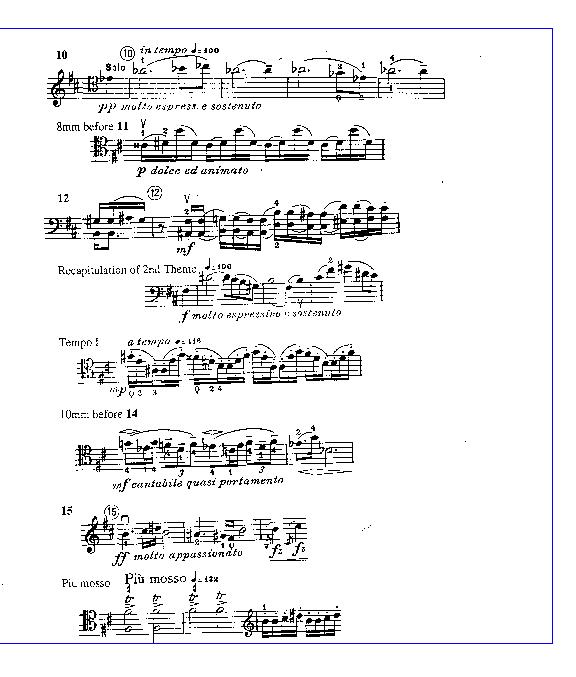
Returning to consideration of the six selected recordings, a specific comparison of tempos in the first movement further reinforces the differences suggested by the overall timings, in more meaningful detail. No performer plays in a strict metronomic fashion, so it is difficult to assign metronome markings for any section that are entirely accurate. While Dvorak indicates only two different tempos for the entire movement, all of the cellists in these recordings make additional tempo changes, which are traditional but not specifically indicated in the score. To get a practical map of each performers' tempos, the movement can be divided into 13 general tempo sections, though some of these sections contain accelerandi or other subtle tempo changes within. The starting points for each of these sections are as follows:
From
these we can construct a basic 'map' of each performers
tempos throughout the movement as follows:
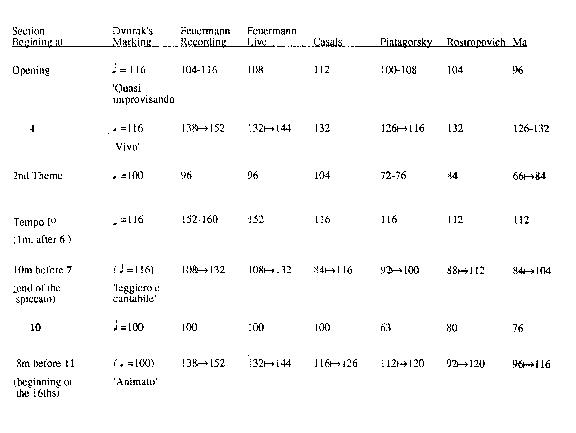

The opening section finds all the cellists in more or less the same tempo range, with Casals producing the quickest and most straightforward version and only Ma significantly slower (and also somewhat more erratic rhythmically) than the rest. At the following 'Vivo' section, Feuermann's tempo is near that of the others, who are all significantly faster than Dvorak's indication. The difference comes with Feuermann's gradual accelerando during the technically challenging passage work in the measures prior to 5, which leaves him at a significantly faster tempo than the others. Piatigorsky, in contrast, ritards in this difficult passage. This illustrates a tendency seen frequently with Feuermann. In climactic passages which are also technically demanding, while other cellists often slow slightly to accommodate the passage work, Feuermann tends to accelerate, giving the impression of breathless excitement and daredevil risk taking.
It is in the second theme, and other slower, more lyrical themes, that the contrast between Feuermann and Casals versus the latter cellists becomes more apparent. In the second theme, which Dvorak indicates at q =100, Feuermann plays (both times) at q =96 and Casals plays at q =104. Rostropovich plays much slower at q =84, Piatigorsky even slower at q =72-76 and Ma begins at only q =66, only reaching q =84 after the accelerando at the end of the passage. When we examine this passage in detail later in this chapter, an interesting connection is seen. The cellists who choose the slower tempos are also the ones who engage in the largest amounts of rubato.
Without arguing whether playing more slowly is more or less desirable, we should consider the difference that a quicker or slower tempo makes in the listener's perception. For the purpose of demonstration, consider the analogy of a sentence. There is a natural speed at which the spoken sentence is easily understandable. If the words are spoken too quickly, the details blur. If spoken too slowly, the overall meaning of the sentence becomes difficult to focus on, as each individual word and inflection takes on an exaggerated importance. This phenomenon is described in the science of Information Theory and applies to any transmission- whether audible, visual or electronic- which contains 'information'. Thus the same principles can be seen in a musical phrase. Playing too quickly for the brain's ability to analyze information would cause important details to be missed. Playing too slowly would cause the focus to shift away from the larger phrase and towards the details of each small segment or even each note. This is intuitively understood by many musicians who teach that 'playing faster helps to bring out the long line'. Thus, when choosing to play the second theme at much slower tempos, Rostropovich, Piatigorsky and Ma are, perhaps unwittingly, shifting the listeners perception from the larger structure towards the individual notes and small 'sub-phrases'.
In the Tempo Io section following the second theme, Feuermann plays the spiccato sextuplet figures at a much more rapid tempo than any of the other cellists. All the cellists make a ritard at the end of this figuration into the next section, after which they accelerate to the end of the exposition. Here again, although they all follow a similar framework, Feuermann is distinctly faster than the others. The entrance of the cello at 10 shows again how exaggerated the differences between the cellists becomes in the slower passages. Dvorak's marking is q =100. Casals and both Feuermann versions are at that tempo. Rostropovich is 20 points lower at q =80, Ma even slower at q =76 and Piatigorsky playing only at q =63. In the Animato that follows, all the cellists make an unwritten but traditional accelerando into 12. Again Feuermann is much faster, and again we see Feuermann's tendency to accelerate in sections where both the musical tension and the technical difficulty are increasing. The differing impact of Feuermann's tempo upon arrival at 12 at q =152 and Ma's at q =116 must be heard to be truly understood.
The ensuing restatement of the second theme and subsequent material in B major follows much the same pattern as before, though all the cellists play the second theme a bit faster this time except Casals, who starts slightly slower this time and then accelerates. The tempos of the spiccato sextuplet section were similar to the tempos of its first occurrence for all the cellists, but in the accelerando in the following section, Casals and Feuermann made even more accelerando than they did in the earlier statement, while the other cellists played much as they had the first time. In the coda and ensuing Più mosso we again see Feuermann clearly faster than the others, and again accelerating through the technical difficulties towards the climax, while the others held steady or slowed. Here Feuermann is much faster than Dvorak's indication, ending his recorded version at a stunning q =176 where the marking in the score is q =132, which the other cellists approximately adhere to. Feuermann's spectacular tempo is certainly compelling to the listener, but Feuermann later moderated it somewhat when he ended the live version, twelve years later, at q =160, still much faster than any of the other cellists but slightly slower than his tempo for the recorded version.
From this discussion of timings and tempos, it is obvious that Feuermann performed at tempos much faster than those of the other cellists, with only Casals' tempos anywhere close. Clearly tempos have a large effect on how the music is perceived by the listener, and Feuermann's choice of tempos clearly contributes to the difference between his style of playing and that of other cellists. But it is also obviously only one aspect of what distinguishes Feuermann's playing .
Another thing that becomes clear, when trying to attribute metronome indications to these recordings, is how much the listener's perception of rhythm differs from the reality of the metronome. While Feuermann's performances seemed to provide the clearest 'feel' of the beat -meaning that to a listener, the rhythm and tempo seemed the most clear and compelling- when trying to set a metronome, one found a slightly changing tempo throughout almost every measure -a constant rhythmic 'push and pull'- making metronome indications sometimes recordable only as a range between two or three adjacent markings or as an average. At the same time, other performers, particularly Rostropovich and Ma, whose performances did not yield to the ear as strong a sense of tempo or rhythm, fit more easily within a specific metronome marking. From this, it is clear that the feeling and perception of rhythm are conveyed much more by the performers choice of emphasis or 'pulse' than by strict adherence to any absolute metronomic rhythm.
Listening to Piatigorsky, one gets the feeling that he is frequently ritarding, seemingly in almost every phrase. Listening to Rostropovich and Ma, one gets the impression of much slowing down and speeding up, sometimes seemingly capriciously. Casals, in contrast, seems to be the 'straightest' of the group. With Feuermann, while one might sense a small 'pushing and pulling' of the rhythm in the course of the phrasing, one is only really aware of a tempo change during the major tempo changes. Perhaps this is the result of more subtle use of rubato or by his emphasis of key notes (and avoidance of emphasis on notes which are only transitory and rhythmically weak) to create a clear sense of pulse, even if the rhythm is not metronomic. Perhaps he is also aided by a quicker tempo, which shifts the listener's focus towards the larger outline. In any case, it seems that for Feuermann, the sense of rhythm is created by the way he phrases.
In a 1987 review in The Strad, Harris Goldsmith makes similar observations about the performers' tempos and use of rubato in comparing three of the same recordings of the Dvorak (Feuermann, 1940, Casals, 1937 and Ma, 1986) that we have considered:
"...In 1940-41 when these performances took place, Feuermann's
style doubtless did sound more 'modern' than Casals'
- leaner, more brilliant, less rhetorical and effusively
emotional. What I find instructive listening to the
playing forty-five years later is how similar
the Feuermann manner was to Casals' in its essentials
- and how far removed both these masters are
from today's norm. The biggest change is in our attitude
towards forward direction: one has but to juxtapose
either this 1940 Feuermann/Barzin recording of the
Dvorak Concerto, or the 1937 version of same by Casals
and Szell, with a fine modern performance such as the
newly issued Yo Yo Ma/Maazel/Berlin Philharmonic(CBS...)
to appreciate how much the pendulum has swung to the
other side. (The contrast is even more noteworthy since
Maazel is generally regarded as being a "precisionist"
maestro in the same "objective" and technically-oriented
tradition as Barzin and Szell.) Whereas both Feuermann
and Casals project the music's tensile qualities with
impelling thrust, Ma, and, more crucially, his conductor,
take slower tempos and seize upon every excuse for
a tenuto as if forward motion was to be equated
with insensitivity.
...(in the 1940 Feuermann recording) much of the rapid
high position passagework is cleaner, more assertive,
than on the Casals record, but, as with Casals, there
is an ardour, a willingness to take chances...And present,
too, is a
marvellous sense for the long line...It (the 1940 Feuermann recording) is, everything considered, a very great interpretation (which will, one hopes, gain adherants and help reverse the current fondness for lugubriousness.)" [4]
VIBRATO
While each cellist's usage of vibrato varies from note to note, their overall patterns and differences are consistent throughout the recordings. It is difficult to discuss vibrato in any kind of absolute terminology. The factors which may vary are the width and speed of the oscillation, and the change in these throughout the duration of a note. Even if it were possible to make a quantitative representation of these factors for each cellist, it would not necessarily be enlightening. It is more practical to pick one recording as a point of reference, in this case the earlier Feuermann recorded version, and compare the others to it. Since it is clearly easier to notice the differences between vibrati on slower, sustained passages, the second theme of the first movement and the opening of the second movement were two of the major sections used for comparison.
Compared to Feuermann, Casals' vibrato is sometimes slightly wider, though generally the same approximate width. It is almost always slower, however, producing a less 'active' sound. Casals' vibrato was not applied to all notes as consistently as Feuermann's, as some notes had an initial impulse of vibrato which then tailed off, while others sometimes stood out in contrast because they had no vibrato at all. Casals also sometimes began the vibrato just slightly after the note had begun to sound. This effect is definitely noticeable in terms of the type of sound it produces, but its cause is not easily identified unless one is specifically listening for it, as the delay is a very subtle.
Piatigorsky uses a vibrato that sounds much sparser and more constrained than Feuermann's. In comparison to Piatigorsky, Feuermann's vibrato sounds as if it has more 'beats' -i.e. vibrato impulses- per note, and that these impulses come more quickly. Furthermore, Feuermann's vibrato carries through the note, while Piatigorsky's tends to trail off. The actual physical dimensions of Piatigorsky's vibrato are narrower and slower than Feuermann's, and in this recording, his use of vibrato is also much sparser than Feuermann's. With Piatigorsky's vibrato, the effect resulting from beginning the vibrato slightly after the note has begun to sound is a little more pronounced than with Casals.
Rostropovich's vibrato is much wider than Feuermann's, and also slower. It is, in fact, the widest vibrato of the five cellists. Rostropovich also, to a greater extent than Piatigorsky and Casals, plays many notes with no vibrato, which therefore stand out in the phrase because of their different sound quality. The 'delayed vibrato' effect is also more noticeable with Rostropovich than with the either Casals or Piatigorsky.
Ma's vibrato is much slower than Feuermann's and is, in fact, slower than the vibrato of any of the other cellists. It is also almost as wide as Rostropovich's, but, in contrast to the other cellists, whose vibrato tends to be centered, varying evenly above and below the core pitch, Ma's vibrato occasionally becomes uneven, leaning towards the higher pitch and producing a somewhat irregular oscillation. What is strikingly different about Ma's vibrato, however, is the extent to which he delays the production of vibrato on some notes. Whereas the effect with the other cellists was relatively small and sometimes difficult to identify, with Ma the delay is much larger and the vibrato furthermore tends to increase throughout the note, producing a type of 'swell' which is very noticeable. Ma also produces the largest number of notes without vibrato. In addition, his vibrato speed is more variable from note to note than that of the other cellists.
Comparing Feuermann's vibrato on the live 1940 recording with that on his earlier 1928-29 recording (which was the standard used for the comparison to the other cellists) it seems that, though Feuermann's vibrato in the later version is still the same width and consistency, and still begins precisely with the sounding of the note and sustains through it as in the earlier version, the speed of the vibrato has now increased. This is the opposite of what one might expect from the now older Feuermann, as many cellists' vibrato speed slows with age, but the effect of this faster vibrato makes the sound quality more focused and adds a greater underlying element of tension to the sound. One can not help but wonder whether this change in his vibrato might have been influenced by Heifetz, with whom he was now collaborating regularly. Certainly the character of his vibrato at this time sounds very similar to that of Heifetz's.
Besides the greater speed, the major difference between Feuermann's vibrato and that of the other cellists was the initial impulse. His students have sometimes described the initial sounding of a note with the Feuermann vibrato as an 'impulse' from the left hand. If this impulse actually results in more vibrato at the beginning of the note and then a slight relaxation, the effect is almost too subtle to detect. What is clearly noticeable, however, is that the vibrato begins exactly with the sounding of the note, whereas for the other cellists, the vibrato begins, to varying degrees, after the note has begun to sound. Since adding vibrato to a note that has already sounded without vibrato intensifies the character of the sound, the vibrato technique of the other cellists produces at least a slight swell after the beginning of most notes. Feuermann's notes, in contrast, began with full vibrato, and thus maximum intensity, at the start, from which point it is either sustained or relaxed. While this might seem a relatively minor technical point, the difference made by having the maximum intensity of sound at the beginning of the note rather than having an intensification during the course of the note makes an enormous difference, and was integral to Feuermann's sound and manner of phrasing. Considering its overall effect, it is a striking difference between Feuermann's playing and that of the other cellists.
The second major difference could be described as consistency of application of vibrato. All of the other cellists studied tended, to varying degrees, to let the vibrato trail off during the course of a note, and also to produce notes with no vibrato at all in the middle of otherwise heavily vibrated passages, drawing attention to these notes in a manner that was presumably not deliberate. For Feuermann, it seems that the vibrato was as integral a part of producing the note as stopping the string, and that he would rarely do one without the other, unless in a passage so rapid as to make it impossible. Feuermann also vibrates on notes which many other cellists do not or can not. One example of this is the octave passage at the end of the first movement of the Dvorak:

Here Feuermann vibrates on the top note of the octave which most cellists do not, producing a vibrant, 'alive' sound almost akin to a violin. Furthermore, only rarely do you hear a swell or diminuendo effect produced from Feuermann's changing the speed of vibrato during the course of a note, and only when it is intentionally produced to coincide with a crescendo or diminuendo made by the bow. The swells produced by Ma's delayed application and changing intensity of vibrato produce the effect of many small crescendi, sometimes on each successive note, and it seems possible that it is done more from habitual reflex than deliberate choice.
Though Feuermann's approach to vibrato seems unique among cellists, it is not dissimilar to that of Heifetz and other violinists of the era, and the type of focused, intense sound that it produced may have contributed to the impression given by so many of his contemporaries that he was 'playing the cello like a violin'.
GLISSANDI
While it is difficult to make generalizations about the cellists' use of glissandi without referring to specific examples, it is very clear to anyone who has ever heard a Feuermann recording that he employs them to a much greater extent than most other cellists. As he explained to David Soyer [5], his use of glissandi related to his philosophy that the cello is "not a clarinet. You don't just cover the holes with your fingers." He believed that the cello should have the same fluidity as the human voice and that the glissandi he employed helped to make it sound so. But there were major differences in the way Feuermann produced his glissandi in comparison to the other cellists.
Consider the factors a cellist may control in the production of a glissando: the speed of the glissando, and the volume, including crescendi and decrescendi, with which it is produced (which depends on the pressure, speed and placement of the bow.) In spite of all the complications that arise when one considers the many different techniques of producing glissandi that are employed, these are the only significant factors which can vary. It is important to clarify here the difference between a glissando and a change of position, both of which are often referred to as 'shifts'. It is generally agreed that it was Casals' innovation to shift positions without necessarily producing an accompanying glissando, as his predecessors had done, often in a manner that many considered vulgar or even grotesque. It is clear from Feuermann's teaching that he was very much against the incidental production of glissandi as a byproduct of changing positions, and from the recordings it is also clear that Feuermann produced glissandi only where he chose to, and that he conscientiously avoided producing glissandi otherwise.
What is immediately obvious in examining Feuermann's glissandi is that, despite the fact that he employed them to a great extent, the glissandi do not receive a great deal of emphasis, either from the amount of time taken in producing them or from their dynamic. They seem rather more like a type of 'connective tissue' between notes than an event in their own right. Whatever the degree of emphasis that Feuermann gave a glissando, the arrival and departure notes received more.
Feuermann's slides tend to fall into certain distinct types: when making a descending [6] glissando, Feuermann almost always decrescendos, with the important emphasis going to the top (departure) note and uppermost part of the glissando. Frequently, Feuermann performs the glissando by traveling back on the finger which played the top note, only switching to the lower finger when the arrival position has been reached. This produces a glissando that does not sound in the very last portion prior to the arrival note, which helps to emphasize the upper portion of the glissando and matches the decrescendo. For ascending glissandi, Feuermann employed both crescendi and decrescendi. In either case, it is proportionally the upper part of the glissando which is heard, and it is the arrival note which takes precedence as the musical 'event'. In fact, some Feuermann glissandi are so subtle that they require repeated listening simply to become clearly aware of them.
Casals, in contrast, produces glissandi that tend to be slower and more evenly emphasized throughout the course of the glissando. When he makes a glissando, one is much more aware of it. In contrast to a Feuermann glissando, Casals would tend to depart more quickly from the departure note, travel more slowly through the course of the glissando, and sustain the same dynamic throughout the course of the glissando. This created a much larger, more obvious effect, sometimes overshadowing the departure and arrival notes. In addition, Casals sometimes emphasizes the lower part of the glissando on downwards glissandi, where Feuermann would do the opposite. Casals employed glissandi less frequently but, because of his method of producing them, more obviously than Feuermann.
The other three cellists make much less use of glissandi than either Casals or Feuermann. In the case of Piatigorsky, many of his few obvious slides are short slides of a whole or half step. While some of Piatigorsky's glissandi employ a release of tension similar to Feuermann's, others, particularly the shorter slides, are produced in an even, heavily emphasized style and slower speed, more similar to Casals.
Rostropovich also makes few glissandi. One which is particularly noticeable, and unique to him in this comparison, was a type of heavy downward glissando over a large distance, fast and heavily emphasized, and with the major emphasis on the lower part of the glissando. An example of this can be seen at 1 m. before 5 :

The few other types of glissandi Rostropovich makes are fairly fast, but with a constant dynamic throughout,. They sometimes seem almost to be incidentally produced by shifting, and produce a sound that has been rather vividly described as 'slurpy'.
Ma employs more glissandi than Piatigorsky or Rostropovich, though they similarly tend to concern the change of position in small intervals. His glissandi are produced at a slow speed with heavy emphasis throughout, producing a very noticeable, and more extremely emphasized effect than any the other cellists. An example of this can be seen 3 mm. before 6 :
 Here Ma
makes a heavy glissando from the E to the A and then
another heavy glissando from the A back down to the
F#. These heavy, slow glissandi tend to draw the listeners
focus away from the melodic line.
Here Ma
makes a heavy glissando from the E to the A and then
another heavy glissando from the A back down to the
F#. These heavy, slow glissandi tend to draw the listeners
focus away from the melodic line.
In Feuermann's 1940 live recording he employs a greater number of glissandi than in the 1928-29 version, but the glissandi are of lighter character. The glissandi on the earlier recording are sometimes slightly slower and more emphasized. In the later recording, the glissandi are more numerous but less obvious.
Besides his greater use of glissandi, what is clearly different about Feuermann's glissandi, in comparison to those of the other cellists, is his technique of producing them with only enough emphasis to affect a connection between notes, but not so much as to distract from the musical line. More specifically, it seems as if most of his glissandi are accompanied by a feeling of relaxation or release. On the descending glissandi, the emphasis of only the upper part of the glissando ensures that it does not disturb the natural release of tension that is usually involved in descending melodically. When other cellists occasionally produce descending glissandi with more emphasis on the lower part of the glissando than the upper, the effect can sound somewhat distorted. In the ascending glissandi, Feuermann also emphasizes the upper part of the glissando, again following the natural musical line. It is often only the very last part of the glissando, right before the arrival note, that the listener is aware of. Regardless of the degree of emphasis a glissando received, all were produced with the same basic underlying principles.
It is also interesting to note how cleanly and completely without a hint of glissando Feuermann played in those places where he changed position but chose not to make a glissando. These instances clearly show that he did not create glissandi inadvertently. But it was Feuermann's frequent use of subtle glissandi to connect notes without distracting from the overall phrase that was one of the unique and immediately recognizable aspects of his playing.
A cautionary note: it is almost impossible to accurately describe all the subtle differences between glissandi in words. Certain details that are obvious to the ear defy verbal description. General differences in approach have been outlined here, but to completely understand the differences between the cellists glissandi, one must also hear the recordings.
DETAILED COMPARISON
Many of the details of phrasing can only be seen through detailed examination of an interpreter's performance. To better understand each performer's use of accents, emphasis, dynamics and rhythm, we must focus more closely on specific sections. Rather than attempting to discuss with each cellist every different technical factor that helps creates an emphasis on a given note, it is simpler and probably more meaningful to approach the discussion from the listener's perspective, noting simply on which notes the performers create emphasis. Typically this emphasis results from stronger bow pressure or speed, but other factors may also cause or contribute to a note's feeling of emphasis, including accents, vibrato, slides, the relative dynamic level, etc... For instance, a crescendo during the course of a note (which will also be described as a swell) would cause the normal emphasis, on the first part of a note, to be overshadowed by the latter part of the note. Similarly a slide into a note, a greater or lesser amount of vibrato on a note, or any other factor which distinguishes a note from the surrounding notes could contribute to the amount of emphasis it receives in the ears of the listener. In short, the 'emphasized' notes are those to which the listeners attention is drawn. Typically these are the climactic points of phrases. The term 'focus' of a measure or phrase is used to refer to the point within the measure or phrase with the greatest amount of emphasis.
We will consider two excerpts: the initial entrance of the cello in the first movement and the second theme, which provide an interesting contrast in which to observe the performers. For simplicity of reference, these excerpts are reprinted before the discussion:

The opening motif (mm.1-2) provides immediate contrast. Feuermann extends the rhythmic value of the initial B and shortens the 16th notes, while placing the important emphasis on the B's of the first and third beats. Casals similarly lengthens the opening note and shortens the 16ths, but makes a swell on the second B of each measure, moving the emphasis towards the very end of the measure, away from the second B.
Piatigorsky also lengthens the opening B, but does not correspondingly shorten the following 16ths, and also puts an accent on the first 16th -the C#- moving the focal point of the measure to that note. Piatigorsky also makes a crescendo on the B in the second half of the measure. In the second measure, unlike the first measure, Piatigorsky does not lengthen the B, but does shorten the 16ths this time, again adding an element of rhythmical ambiguity. Whereas with Feuermann and Casals the emphasis for both measures was on the first (and for Feuermann third) beat B's, with Piatigorsky, the emphasis was on the C# 16th in the first measure and the B on the first beat of the second.
Rostropovich plays the first measure fairly rhythmically, also crescendoing through the second B, and playing the 16ths in a much more legato fashion. In the second measure, however, he elongates the 16th notes, moving the focal point of the measure towards the 16ths.
Ma shortens the 16th notes greatly and also plays them somewhat unevenly, making a slight accelerando. He also places heavy accents on the opening B, the first 16th C#, and swell on the third beat B, which he shortens more than the other cellists, making it almost a quarter note. In the second measure, he places emphasis on the opening B and the first 16th A, though the 16ths are this time at full value, making a rhythmic contrast with the first measure. The third beat B is shortened and swells as in the first measure. Only Feuermann and Casals play the rhythm and accents of both the first two bars similarly, and in the Feuermann version the focal point of each measure is clearly on the first and third beat both times.

In the following measures (mm.3-4) all the cellists increase the tempo somewhat, with all the cellists placing the greatest emphasis on the third beat D#. For Feuermann, the tempo is immediately faster and the rhythm is proportional. Clear emphasis is also heard on the first two beats, though the third is clearly the arrival point. In the following chords, Feuermann is unique in this group of cellists in his creating a slight decrescendo during the descending chord sequence, though still giving each chord strong emphasis.
Casals places a heavy emphasis on the first beat, as well as the arrival at the third, and plays the following chords in a very short detached manner. Piatigorsky also places emphasis on all the first three beats, but his accelerando is noticeably different in that the first 16th note seems to fall too quickly, even for the new tempo, giving an element of rhythmical ambiguity to the new tempo.
Rostropovich plays the down-beat of m.3 slightly earlier than would be expected based on the tempo of the previous measure, and shortens the first 16th note to approximately a 32nd and the second 16th to a value about halfway between a 16th and 32nd. The tempo of the ensuing chords is immediately slower, though there is a slight accelerando and ritard during the course of the chords.
Ma lengthens the first B on the down-beat of m.3, which he follows with a very short 16th and an accelerando through the second beat to the accented third beat. This third beat emphasis, however, is detracted from somewhat by a crescendo during that note. The tempo of the ensuing chords seems to have little relation to the earlier tempo in the measure, being much slower, though he does make a small accelerando during the course of the chords.
The ensuing four measures (mm. 5-8) follow similar patterns to the first four measures except that Casals now lengthens the 16ths in m.6, increasing their proportional importance in the measure.

In mm.9-12 Feuermann plays in almost the identical tempo to the previous measures, making only a slight accelerando from the end of m. 11 to the fourth beat of m.12, where he pulls back. He accents each beat of the first two measures, in accordance with Dvorak's fz indications, though the largest emphasis is given to the third beat. In mm.11-12, Feuermann places the major emphasis on the down-beat of measure 11, and then no major emphasis until the four 16ths on the fourth beat of m.12, marked pesante , which Feuermann accents.
Casals takes a tempo at m.9 which is immediately quite a bit faster than that of the preceding measure, and goes faster yet at m.11. The main accents in mm.9-10 are on the first beats of the measures, and mm.11-12 are played quite 'straight' with relatively little accent or accelerando, even on the pesante 16ths.
Piatigorsky starts m.9 a little faster than the previous measure, but the tempo of the dotted eighth/sixteenth figures on beats three and four seems not to match the tempo of the 16ths in the first part of the measure. The main emphasis in the first two measures is on the third beat, but there is also an accent on the third 16th of the first beats of both measures, preceded by a crescendo over the first two 16ths. In m.12 Piatigorsky makes an accelerando and then a ritard over the course of the last two beats. This ritard starts earlier and slows more, in comparison to Feuermann's at the same section.
Rostropovich begins m.9 in approximately the same tempo as the previous measure, and plays the next two measures in this tempo, though he shortens the 16ths of the third beats to 32nds. At the down-beat of m.11, Rostropovich goes immediately much faster, and makes a tremendous accelerando over the next few beats. At the down-beat of m.12, he holds the down-beat C and then makes a very big ritard into m.13
Ma accents each beat in mm. 9-10. His tempo is suddenly faster than in the previous measure, but the last 16th of the first two beats is too short relative to the previous three, producing a slightly arrhythmic 'limping' effect. Ma also accelerates through the third and fourth beats of both these measures. In m.11, Ma makes a small ritard over the first three notes and then an accelerando until the pesante , where he ritards.

In mm.13-16, Feuermann places a strong emphasis on the down-beat F#. The tempo in m.13 is established by the orchestra, but when Feuermann again has moving notes in m.14, he takes a tempo which is slightly faster than that of the orchestra. A slide into the D# on the fourth beat of m.14 gives that note a certain amount of emphasis, and Feuermann makes a small tenuto there. This does not create the effect of a ritard, however, as the following G is shortened and the down-beat of the next measure falls where it would have in the original tempo. Feuermann makes a small ritard on the last beat of m.16 and slides into the final G, and the consequent emphasis makes it the focal point of the measure.
Casals also begins m.14 slightly faster than the orchestra's tempo, and slides to the G, the last note of m.14. This slide, combined with a ritard, puts the main emphasis on this note. In m.16 Casals makes a slight accelerando and then a ritard, giving a slightly uneven feel to the overall rhythm. Casals also slides and ritards into the final G in m.16, again making it the 'arrival' point. Piatigorsky similarly ritards in the last beats of m. 14 and 16, and makes a similar slide into the final G of m.16.
Rostropovich begins m.14 at a much faster tempo than the orchestra, and again in m.16 starts much faster than the orchestra's tempo in the preceding measure. In m.16 he accelerates and then ritards, with the ritard becoming extreme on the fourth beat. The overall effect is somewhat chaotic rhythmically.
Ma begins m.13 with a large accent, but no vibrato, which produces an unusual sounding accent, with a harsh attack and a quick decay. He accelerates through m.14 and makes a similar type of accent on m.15, except that this time he adds vibrato as the note continues. He accelerates through m.16 until the last beat, and makes a slow and heavily emphasized slide to the final G.

In the trills (mm.17-23) Feuermann is immediately somewhat faster. He follows the crescendo to m.22 and this down-beat is given the greatest emphasis, though the C# on the fourth beat of this measure, and the B and A# on the first and third beats of the following measure also have significant emphasis. Feuermann makes a ritard in m.23 and then begins the Vivo at a new faster tempo.
Casals places the emphasis similarly to Feuermann except that he makes a swell on the A# and B of m.21. This means that instead of the main emphasis going to the beginning of each of these notes, it goes to the latter part, and the beginning of the following note is a slight dynamic drop. Casals plays m. 23 going into the Vivo with very little ritard.
Piatigorsky holds the base note of each trill before beginning the trill, making it heavily emphasized and making the trill sound relatively less emphasized. He emphasizes m.22 and 23, and ritards before m.24, but the last three trills before the Vivo have a very noticeable decay in volume, giving the effect of a small decrescendo on each note.
Rostropovich's version is most noticeably different in that the tempo he takes for these measures is actually faster than his tempo for the 'Vivo' section, so that when the 'Vivo' begins, he actually slows down a bit from his previous tempo. Otherwise, the general line that he follows is similar to that of the other cellists.
Ma's version is noticeable for its extreme accent and subsequent decay on the first trill. He follows Dvorak's fz, decrescendo marking in this way, and then plays the following trills very much in a piano dynamic. This approach is unique among the cellists studied here, but the success of this effect will have to be judged by the listener. Ma makes swells on both the trills in m. 21, shifting the emphasis towards the ends of each of those notes, and then makes a large accent on the down-beat of m.22. This accent is followed by a diminuendo through the course of the note, and then there is another swell on the following C#, and again on the final A# before the Vivo.
The second section considered is the second theme of the first movement:

In mm.1-4, Feuermann places the major emphasis on the down beats of m.1 and m.2, the third beat of m.3 and the first and fourth beats of m.4. He elongates the first F# of the first measure slightly, and then moves forward on the following eighths to compensate. He also moves forward through the first three beats of the second measure, and pulls back on the fourth beats of m.3 and m.4. Casals interpretation is much the same, except that he decrescendos on the fourth beat of m.4, and hence does not emphasize it as Feuermann does.
Piatigorsky 's choice of emphasis is similar, but he makes much larger ritards. He takes a small pause before the fourth beat of m.2 and then makes a large ritard through m.3, and another again in m.4. Besides the larger proportion of these ritards, what is different from the ritards of Feuermann and Casals is that there is less sense of a resumption of the original tempo following the ritard. While the ritards of Casals and Feuermann could be considered 'pushing and pulling' the phrase, Piatigorsky seems only to be slowing down.
In Rostropovich's version, a swell on the first F# in the first measure moves the emphasis towards the latter half of the note. The second eighth note, the D, also receives a strong emphasis. The down-beat of m.2 is emphasized, and the next three beats have a small accelerando, but the open A string on the third beat is so loud as to give it a (presumably) unintentional accent and the fourth beat D is also emphasized. There is also a slight pulling back going into the down-beat of m.3, and emphasis is also given to that down-beat. Rostropovich also differs from the previous cellists by decrescendoing to the top A on the third beat of m.3. He makes a slight ritard on the last two beats of that measure, and also a ritard on the last beat of the fourth measure.
Ma begins the whole passage at a very soft dynamic, but immediately makes a swell during the course of the first F# in m.1. While he accelerates to the third beat of m.3, he makes a decrescendo on the fourth beat, drawing the focus of the measure away from the third beat. Ma makes a very large ritard on the fourth beat of m.4. What is most notable, however, are the numerous small swells, as many notes tend to begin very softly and than increase in intensity during the course of the note.

In mm.5-8, Feuermann emphasizes the down-beat and the first eighth note of m.5, the down-beat and the fourth beat of m.6, and the third beat of m.7. He ritards slightly through the three eighth notes in m.5, elongates the F# on the third beat of m.7, and pulls back the tempo slightly on the following triplets. He also pulls back on the fourth beat of m.8 which is, of course, actually the beginning of the next phrase.
Casals emphasizes the first beat of m. 5, but lengthens the second eighth note, the D, making the last two eighth notes sound almost like a dotted eighth/sixteenth pairing. This naturally adds emphasis to that D. While Casals similarly emphasizes the A on the fourth beat of m.6, he crescendos during the note, adding more emphasis towards the latter part of that note. Casals slides into the third beat of m.7 and lengthens this F#, but doesn't make much ritard on the following triplets. Casals also pulls back the fourth beat of m.8, and plays these up-beats at a much softer dynamic.
Piatigorsky continues his ritard from m.4 over the first three beats of m.5 but, though he never really regains the tempo, the A on the third beat of m.6 falls earlier than would be expected. Piatigorsky likewise gives the most emphasis to the F# on the third beat of m.7, and makes a large ritard over the course of the final two beat of this measure. Like Feuermann and Casals, he also ritards in the last beat of m.8, but slightly more so.
For Rostropovich, the third beat of m.6 similarly comes earlier than would be expected. The striking difference, however, is that Rostropovich decrescendos into the third beat of m.7, which the previous cellists had made the arrival point of their phrases. This decrescendo also makes the following E, which begins the triplets, seem to stand out with special emphasis. Rostropovich ritards in the last beat of m.8 and drops down to a pianissimo dynamic, which he maintains throughout the next phrase.
Ma again makes a swell on the first note of m.5, and on the first note of m.6. He makes the A on the fourth beat of m.6 the high point of his phrase, and decrescendos from there into m.8. He ritards through the triplets in m.8 and makes a very large ritard into m.9

In the next two measures (mm.9-10) Feuermann places the emphasis on the down-beats of each measure, and makes possibly a slight accelerando through three eighths in m.9. Casals places the emphasis similarly, but makes a swell on the opening B of m.9 and also shortens the third beat of m.10, presumably in preparation for the position change. Piatigorsky, too, makes the same emphases and similarly accelerates through the eight notes in m.9. Rostropovich and Ma are similar, though Rostropovich plays this section pianissimo.

Over the course of the next seven measures (mm.11-17), Feuermann begins a gradual accelerando, which becomes even more apparent at the Animato at m.15 and carries through the end of the section. While Feuermann makes a ritard in the last two beats of m.17 in the earlier recording, he does not in the later live version. The emphases in this section are quite straightforward: In the measures with two groups of two notes (i.e. mm.11, 13 and 15-17) the emphasis is clearly on the first and third beats, that is the first note of each grouping of two. There is no decrescendo to the second note of these groups however, which are also strongly present. In the other two measures (mm.12 and 14) the emphasis is on the down-beat only. The secondary emphasis on the latter note of the groupings of two continues to increase during the section, however, so that eventually the first and second notes begin to have almost the same amount of emphasis. Feuermann makes one significant change to the score at this point, playing the final climactic phrase (mm.15-17) an octave higher than written, yielding a very intense effect. In the live version, Feuermann also effects a small slide into the down-beat of m.13. While the largest emphasis in mm.11-12 is on the F# on the down-beat of m.12, but this slide helps to move the focus of mm.13-14 to the E on the down-beat of m.13, and thus, in both cases, agree with Dvorak's indicated crescendi and decrescendi.
Casals slides into the first E on the down-beat of m.11, and it receives corresponding emphasis. It is the second and fourth beats of this measure, however, which receive the greatest emphasis, effecting a kind of crescendo through each of the two note groupings. While only the down-beat of m.12 is emphasized, the previous pattern is again apparent in m.13, and a descending slide into the fourth beat adds further emphasis to it still. In m. 14, the down-beat F# is emphasized, but there is a crescendo during the following E. In the final three measures each of the quarters notes receives approximately equal emphasis, though a slide into the second beat of 16 gives it further emphasis. Casals also ritards in the final two beats of m.17. Casals' accelerando throughout the section is much less evident than Feuermann's.
Piatigorsky makes a slow slide into the second beat of m.11, causing it to have a strong emphasis. He ritards in the last beat of m.11 and plays the first two notes of m.12 much slower than expected, making them sound more like even valued notes than a quarter followed by a half note. This rhythmic distortion may also be the cause of the fourth beat of the m.12 seeming to sound too early. Piatigorsky then repeats the same slide, ritard and rhythm in the next two measures. From mm.15 to the end, after a small tenuto on the down-beat A of m.15, his phrasing is fairly straightforward, with the traditional ritard on the final two beats of m.17.
With Rostropovich, the emphasis on the latter note in the groups of two is even more pronounced, giving the effect of a crescendo through each group of two. In m. 12 and m.14, though he does not change the rhythm of the first three beats, the fourth beat still seems to come too quickly, as with Piatigorsky. In mm.15-17, the emphasis of the second note of each grouping becomes even more pronounced, as he does not vibrate the second and fourth beats of mm.15 and 16. His accelerando begins only at the Animato at m.15
Ma accelerates through m.11, but pulls back at m.12. He accelerates again through m.13 and then somewhat more at the Animato. He also emphasizes the second note of the groupings of two to an extent, mainly because certain notes are without vibrato and hence stand out to the listener, receiving undue emphasis. Ma also makes a very slow, heavy slide into the fourth beat of m.13, and similar slides both ascending to and descending from the A on the down-beat of m.15, creating a situation where the listener is more aware of the two slides than of the notes that they connected.
While some patterns do become clear from this method of describing these excepts, there are also details which are impossible to fully describe. All the cellists studied here accelerate and ritard, slide, accent, crescendo and decrescendo, and otherwise shape the phrase. The difference with Feuermann is really seen is in the timing, degree and extent to which these effects are used. Consider, for example, the performers use of rhythm. The performers accelerandi and ritardandi were measured here by beating as many subdivisions of each note as possible, to get an accurate sense of the motion of the beat. With Feuermann, the beat accelerated and ritarded more from note to note than with any of the other cellists, making it the most difficult to follow. And yet the magnitude of these variations, particularly the ritardandi, was nowhere near as great as with Piatigorsky, Rostropovich and Ma. The other cellists were much stricter rhythmically on a microscopic scale, but on a larger scale, they were more variable. It is difficult to completely appreciate this difference in this general analysis.
Other issues which were difficult to fully describe include the degree of emphasis on notes, and the subtle use of crescendi and decrescendi. The discussion of crescendi and decrescendi here focuses on those either of broad scope or in highly exposed positions. But all the cellists make subtle natural decrescendos as they relax tension in a phrase and similarly subtle crescendos as the tension increases. What is different about Feuermann is the greater extent to which he does this, producing a more clearly depicted rising and falling line. Also noticeable is the fact that those notes which Feuermann emphasizes receive a clearer emphasis than the emphasized notes of the other cellists. Partly this stems from his immediate use of vibrato and precisely coordinated attack between the two hands, but this also comes from the fact that he does seem to give proportionally more emphasis to those notes which he chose to emphasize, and less to the notes where he did not intend emphasis, than the other cellists. Again, this small but crucial difference is almost impossible to fully account in this analysis.
Despite these limitations, certain patterns do become clear. The major difference between Feuermann and the other cellists, particularly the latter three, seems to be a certain simplicity of effect. It is not that he does not accelerate and ritard, crescendo and decrescendo, slide and accent as the other cellists do, but with Feuermann, it is never done in such a way as to detract from the clear emphasis of the important notes of the phrase. One can make the argument that the other cellists created what appears to be extraneous emphasis in seemingly unimportant places deliberately, because they personally saw these places as important and deserving emphasis. Certainly this must be true in at least some cases. But it is also clear from microscopic examination that all these cellists follow a certain underlying structure in their phrasing, and their general adherence to this framework makes at least some of the unexpected emphases which detract from this structure, seem likely to be unintentional
In this general framework, which they all seem to follow to an extent, the relative importance of each note is influenced by: a) the relative melodic pitch, with higher notes receiving more stress than lower notes, b) the rhythmic placement of the note, with the first beat receiving the most importance, the third beat next (in four), etc.... c) the composers dynamic indications, and d) the harmonic importance of the note. With a combination of these factors a natural musical outline is formed. For example, consider the opening of the second theme:

(Dvorak makes only a general dynamic indication, so it isn't a factor in this case)
Combining these factors the notes that would have the greatest amount of emphasis are:

Whether one agrees with these principles or not, it is a framework that all five of these cellists follow to some degree. Though none of them follows it exactly, the fact that they all stay within the broad outlines of this principle does make it hard to believe that an isolated disruptive emphasis, from a crescendo, slide, unexpected rhythmic placement or other source, is necessarily deliberate. It would be reassuring to believe that all the cellists discussed here controlled and created every detail of their performance exactly as they chose to, but it is very difficult to believe that bow swells, notes without vibrato and irregular rhythms are performed by choice, rather than by a lack of awareness, particularly when they do not recur consistently. While the specific impact of these extraneous emphases may not be consciously realized, their overall effect is to make the direction and focus of the phrase less clear. The difference with Feuermann is that he makes his intended phrasing much clearer, and conscientiously avoids those things which would disrupt it.
Some of what we have described as 'disruptive' emphases and rhythmic alterations are, however, clearly deliberate, particularly in the cases of Rostropovich and Ma, and are the result of a conscious decisions made by the cellists. These choices relate to what is sometimes described as a 'sense of indulgence.' It is clear that adding additional emphases and causing rhythmic ambiguity creates a greater level of complexity in the rhythm and direction of the phrase, and hence a greater level of 'complication' (in the Information Theory definition of the word.) To what extent this complication is considered aesthetically pleasing is a matter of taste, but clearly a greater degree of complication can not necessarily be equated with a greater degree of artistry. Consider an actor reciting the following line of Shakespeare: "To be or not to be. That is the question". A reading in a flat monotone would convey little meaning or emotion. A good actor learns to emphasize certain words. Perhaps "To be or not to be. That is the question" or "To be or not to be. That is the question." or other such emphases and inflections. However if too much indulgence is taken it could become "To be ...or...not to be. That ..is the question" Such a reading would clearly sound ridiculous and overly dramatic, to the point of losing it's artistic effect, but it demonstrates that there is a limit to the extent to which greater complication can make a sentence or, similarly, a phrase more meaningful. In the theater they teach that 'not every word can be a revelation'. So also, not every note can be an expressive climax unto itself.
CONCLUSION
The goal of this comparison is not to say who is 'better' or 'worse' among the five cellists, or, in fact, to draw any subjective conclusions at all. Instead, the goal is to describe everything that can be clearly differentiated that Feuermann did differently from the other cellists. Although the description of small musical details with words is sometimes impossible, several factors are clearly shown.
Feuermann definitely chose tempos much faster than his colleagues, both for faster and for slower sections (though often Casals' tempos on the slow sections were similar.) Feuermann produced a clear beginning for each note, with the vibrato beginning exactly with the start of the note and not slightly afterwards as with the other cellists. The precise coordination of the left and right hands also contributed this extraordinarily clear sounding of each note. Feuermann's vibrato was faster than that of the other cellists, of an average width and more consistent in application. Feuermann used glissandi frequently to produce a sense of connection between notes, but they were generally fast and lightly emphasized. Whatever the degree of emphasis of these glissandi, it was secondary to (though it also, in fact, helped to create) the emphasis of the arrival and departure note. Often only the highest part of the glissando was heard.
Feuermann made many small accelerandi and ritardandi during the course of a phrase, but these effects were never extreme and the overall rhythmic flow was rarely disturbed. Feuermann played with a clear and strong emphasis on those notes which he wished emphasis, and very little on those he did not. He relaxed the tension in between emphasized notes, creating a clearer sense of rising and falling line. Feuermann interpreted similarly to the other cellists, but avoided technical carelessness and interpretive extremes which could distract from his musical line. One of his colleagues summarized it thus "With the other cellists, I hear every note-every swell and gesture. With Feuermann, I am only conscious of the line"
COMMENTARY
This comparison first appeared as if it ought to be simple. As trained musicians we assume that we are aware of, and can explain everything that we are hear and react to, but it is amazing how difficult it is to find symbolism or terminology to describe all the factors that comprise what is broadly labeled as 'interpretation'. It is more shocking still to realize how little time or thought is generally put into the basic factors of phrasing -what we control, how we control it and whether it is desirable or not. By and large, teachers leave it to the student to provide whatever phrasing they are able to produce naturally, only correcting, after the fact, what strikes them as undesirable. We too rarely discuss how to read a piece of music and understand the natural phrasing structure, or the technique of producing what is beautiful and avoiding what is undesirable. Too often we are satisfied only with producing the correct notes and rhythm, with most of the interpretive responsibility left to what comes 'naturally'. We allow ourselves to emote without turning a critical and analytical ear towards the results that are produced.
We entertain a mistaken impression that physically reacting to whatever we feel internally at any given moment will automatically produce something which is beautiful to a listener. While phrasing will always be instinctual and to a degree improvisational, that intuition must be guided by an understanding of the principles that create musical beauty, an ear trained to be aware of these details, and a command of the instrument that will allow a player achieve these goals. There is a shocking belief in some circles that one can only worry about playing the 'correct notes and rhythm with a beautiful sound' since everything else is 'just a matter of taste'. The fact that musical tastes may vary is no excuse for leaving a student unequipped to control or discern the details of phrasing.
You could no more expect a beautifully interpreted performance from a student who is unaware of the details of interpretation than you could expect a moving reading of Shakespeare from a foreigner who knows how to pronounce the phonemes of the English language but has no idea of the meaning of what he is saying. The unrecognizable rhythm, swells and accentuation that such a reading would yield are, in fact, analogous to the distorted rhythms and disruptive accents and swells that are produced by musicians who are unaware of the principles of and unable to control the specifics of phrasing. The results of this comparison point to an alarming direction in cello playing. Many of the trends heard in today's 'modern' cellists, represented here by Rostropovich and Ma, are foreign to the approaches of Casals and Feuermann. We are moving in an alarming direction, and the tragedy is that it is by ignorance and carelessness rather by choice.
Regardless of the readers opinion of Feuermann, Rostropovich, Casals or any of the others, I hope that one will gain from this reading this chapter (as I have in writing it ) not only the details of Feuermann's playing, but also a renewed awareness that meaningful interpretation requires acute detailed awareness of everything that we produce on our instruments, and that interpretation is not only a means of self expression, but also a duty, to the composer and to the audience, to produce what is correct to the intentions of the music and most beautiful.
___________________________
1 This recording was masde in 12 takes in two separate sessions. The first in May, 1928 and the second in October, 1929.
2 In case of multiple recordings, timings were averaged.
3 Harvey Sachs, Rubinstein, A Life (New York: Grove Press, 1955)
4 Harris goldsmith, record Review 1998 (February 1987): 143
5 P. 141
6 For this discussion, the term “descending glissandi” will refer to those that descend melodically and “assending glissandi” to those that ascend melodically.
INTRODUCTION
Feuermann made three commercial performance editions, the Schumann concerto [1], the Boccherini Adagio and Allegro from the Sonata No. 6 [2], and the Mozart concerto, formerly K. 314, transcribed for cello by George Szell [3]. In this chapter, we will examine Feuermann's choice of fingerings and bowings. We will examine the type of fingering patterns chosen (e.g. 1 3 4 vs. 1 2 4, etc...), from which finger to which finger shifts are made and the placement of shifts -both in respect to the rhythmic structure and in respect to the overlying phrase. We will also examine Feuermann's use of slurs (i.e. does he slur notes under the same bow to a greater or lesser extent than the other editors?), his choice in the placement of up and down-bows, and his choice in the placement of bow changes, both rhythmically and within the phrase.
As the objective is to understand what it is that Feuermann does differently from other cellists, and there are no other editions of the Mozart concerto transcription to compare with, and the only readily available editions of the Boccherini are by Stutschewsky and Forino, whose playing styles are less well known, we will focus our attention on the Schumann concerto, which has several performing editions created by well known performers. We will compare Feuermann's edition with those of Stutschewsky, Rose and Schiff [4], representing three distinct generations of performers.
Certain basic assumptions are made in this discussion to follow: A change of bow between notes creates at least a small accent, compared to slurring the same notes. Similarly a change of position in the left hand, whether silent or with a glissando, creates some degree of emphasis on the arrival note. The type of sound and emphasis created by a shift varies depending on the type of shift, particularly depending on whether the shift is from a higher finger to a lower, on the same finger, or from a lower finger to a higher. With descending shifts, the type of hand motion required is the exact reverse of the ascending shift (i.e. 1-3 ascending is the mirror opposite of 3-1 descending). Shifting to or from a harmonic, for which the string is not completely depressed, eliminates some of the emphasis created by the shift and simplifies the mechanics of the shifting. Shifting from an open string allows much more time for the shift since the hand can begin moving towards the destination note immediately following the conclusion of the note prior to the open string. Extensions, in which the hand is stretched to reach a note without leaving its original position, do not necessarily create the emphasis that a change of position would. While most cellists do generally attempt to minimize accents resulting from change of bow and left hand position, some degree of emphasis is heard from all cellists.
Feuermann's editions of the Schumann and Boccherini are unique in their use of a "//" symbol to indicate a break or small separation. While it is interesting to note Feuermann's placement of these symbols, we can not contrast it with what other editors might or might not have chosen, since no other edition uses this indication. Still, by observing their placement in the complete editions (in appendix II), one can gain a better understanding of Feuermann's desired use of separation, and from this, also some idea of his desired use of legato. Since an in depth analysis and comparison of the complete Schumann edition would become both repetitive and unwieldy, we will concentrate on three excerpts, one from each movement: the opening through letter A (mm.5-34) in the first movement, the complete second movement (mm.282-319), and a portion of the third movement from just before letter T until letter U (mm.630-668).
In order to better understand the musical perspective of the other three performance editions, it is useful to know something of the background of the editors.
Joachim Stutschewsky (1892-1982) was born in the Ukraine and studied with Julius Klengel (who was also later Feuermann's teacher) from 1909-12, and then moved to Vienna, where he was a member of the Kolisch quartet and in close association with Schoenberg, Berg and Webern. Following the Nazi occupation of Austria in 1938, he emigrated to Palestine, where he lived for the remainder of his life. He wrote a four volume work on cello technique and a history of cello playing, in addition to numerous compositions, transcriptions and editions.
Leonard Rose (1918-1984) was born in Washington, D.C. and studied first with his cousin Frank Miller in New York and then with Felix Salmond at the Curtis Institute. He later held posts as assistant principal cellist of the NBC Symphony and principal cellist of the Cleveland Orchestra and New York Philharmonic. In 1951 he left the New York Philharmonic post to pursue a solo career, which he continued for the remainder of his life. In addition, he taught actively at both Juilliard and Curtis and edited a large portion of the cello repertoire for International Music. Most of these editions are currently still in print and in common use.
Heinrich Schiff (1951- ) was born in Gmunden, Austria and studied cello with Tobias Kühne in Vienna, and then later Andre Navarra in Detmold. He won competitions in Geneva, Vienna and Warsaw and since has appeared as soloist with orchestras including the Vienna Philharmonic, The Concertgebouw and the Royal Philharmonic. He made his U.S. debut in 1981 with the Cleveland Orchestra and Sir Colin Davis. He performs a wide repertory of works including the Henze concerto, which was written for him and two concertos by Vieuxtamps, which he discovered. In addition to his performing career, Schiff is active as a conductor.
The approximate dates the editions were published are Stutschewsky's c.1940 [5], Feuermann's in 1939, Rose's in 1960 and Schiff's in 1995.
While some general trends can be seen from a comparison of these editions, certain limitations should be kept in mind in such a comparison. Not every fingering indication is present in any of the editions, creating places where several different fingering alternatives might be plausible for that edition. In these cases, we will generally assume the simplest or most 'obvious' fingering, as was most likely implied. Also, occasionally the editors will give two choices for fingerings or bowings, making it unclear as to which the editor would perform. In the Schumann editions, this is true only of the Stutschewsky and Schiff editions, but Feuermann, too, gives alternative fingering indications in his edition of the Mozart concerto.
Most importantly, these editions might sometimes represent the indications that these performers would make for students studying the work, and this does not necessarily imply that these were the fingerings and bowings which they themselves necessarily used in performance or, even if they did, that they were consistent from performance to performance. While Rose and Schiff have made commercial recordings of the Schumann, Feuermann was never able to do so, nor was Stutschewsky. It is clear from the interviews that Feuermann did mark his student's music with fingerings and bowings, but many of the students also referred to his uncanny ability to play almost any different fingering or bowing and produce the same effect. Mosa Havivi speaks of Feuermann changing fingerings right before a performance. He also remembers writing down Feuermann's bowings for the second movement of the Schumann during a rehearsal, and he believes those bowings to be different from those in the published Feuermann edition. The differences seen in these editions are important and revealing, but can not be considered to provide the complete or only account of the performers' choices of fingerings or bowings.
ANALYSIS
Since it is not practical or necessarily informative to discuss every single difference in editions, we will discuss only what seems most meaningful, but the sections of each edition discussed are reprinted here to provide a complete reference. The first section we examine is the opening of the first movement (mm.5-34). (scores on pp.109-111)
In the first few measures, the editions are fairly homogeneous, with the only major difference in fingering coming from Stutschewsky's use of 1-1 or, alternately, 2-2 on the first two notes and suggesting 3-1 as one possibility for the descending eighths in measure 7. Only Schiff's bowing is different, suggesting that measure 7 be slurred entirely. In a footnote to the edition he explains that this slurring would be convenient if one were taking Schumann's metronome marking of q = 130, which is faster than today's
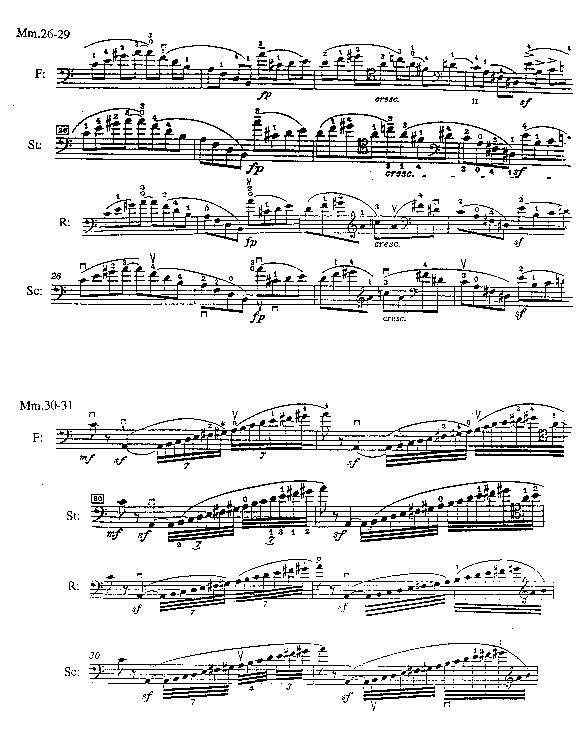
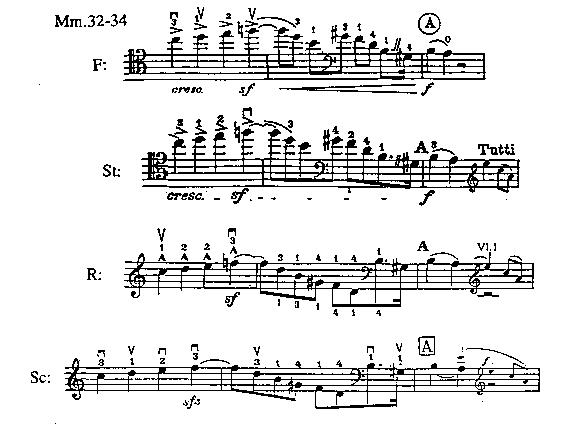
common performance practice, and he further suggests slurring mm.5-6 together in one bow. The first major difference in editions, however, comes with Feuermann's slurring of the last quarter of m. 8 into the next three beats of m.9, which the other editors begin with a fresh down-bow and consequent accentuation. Feuermann's choice of bowing produces slightly less accent both on the pickup to and down-beat of m.9. After this, Stutschewsky follows the same slurring as Feuermann until m.13, but with the reverse bowing. Rose and Schiff, however, take the down-beat of m.13 on an up-bow, like Feuermann, despite being reversed to him earlier. They achieve this by breaking the slurring of the eighth and triplets in m.11, though Schiff has an alternate version (again for a quick tempo, he explains) in which he instead slurs the last two beats of m.11 into m.12. In m.13, all the editors but Stutschewsky separate the last beat from the preceding note, but in the following septuplet an interesting divergence is seen. Feuermann places the bow change on the third beat D, the arrival point of the septuplets. Stutschewsky and Rose place the change on the D, the second note of the septuplets. The accent this creates, in conjunction with the first note of the septuplets being tied to the previous note, makes it seem as if the D is actually the start of a delayed group of sextuplets. Schiff places the up-bow on the last septuplet, Bb, but this seems as if it might be a misprint, since he changes, like Feuermann, on the note following the septuplets when the similar passage is played in m.18.
The only major difference in fingering in mm.9-14 is Feuermann's fingering of the eighth and triplet passage in m.11 on the D string. All the other cellists ascend on the A string, which is much brighter but requires the shift to fall on the third triplet, whereas with Feuermann's fingering it falls on the first triplet note, directly on the second beat. Stutschewsky offers two slides from 2-2, in mm.11 and 13, which seem more prevalent in his fingerings than in the fingerings of the others .
Feuermann's fingering in m.15 is noticeably different from the others in his shifting to 4 on the last eighth of m.15, eliminating the shift (and consequent emphasis) that the other three make on the down-beat of m.16. Feuermann takes the last beat of m.18 and down-beat of m.19 on the D string, while Stutschewsky makes the large shift in order to play it on the A string. Schiff also suggests this approach in his footnotes, though his marking is for the D string. In the eight notes that immediately follow, Feuermann (and Stutschewsky) place the shift directly on the fourth beat and first beat of m.20 and make both shifts 1-2, while Rose places them on the second half of the third beat of m.19 and the down-beat of m.20, making 2-3 and then 1-2 shifts. Schiff shifts on the third beat (3-3) and then on the second half of the fourth beat of m.20 (1-3). Here again we see Feuermann's greater concern for placing shifts on rhythmically strong beats.
Similar bowing patterns to mm.13-14 are seen in mm.17-18 of the editions, though Stutschewsky now slurs the first three beats of m.18. Schiff now, like Feuermann, makes the bow change on the third beat at the top of the scale, while Rose still changes on the 2nd septuplet. In the last half of m.19, Schiff slurs the descending eighths which the other three play separately. In a footnote, Schiff explains that this slurring corresponds to the original sources, but suggests a two note and two note hooked bowing for the final two beats. The slurs create somewhat less emphasis on the eighths than the separate bowing would (or less emphasis only on the offbeat eighths in the case of the alternative bowing.)
The next major bowing difference comes at m.22, where Feuermann (and Rose) slur the eight notes preceding m.23 into the down-beat eighth, presumably allowing the slight glissando that is implied in Feuermann's 3-3 fingering (Rose's fingering is unclear here). Stutschewsky and Schiff make the shift on the preceding eighth and take the down-beat of m.23 with a new bow, creating an entirely different type of emphasis. In m.24-26 Rose diverges from Feuermann, making six bow changes in the course of these three measures to Feuermann's three. Schiff also makes one more bow change than Feuermann, separating the last beat of m.25 from m.26.
Stutschewsky's prevalent use of same finger shifts is again evident in his 1-1 shift in mm.20-21 and 3-3 shift in m.23. The other interesting variances in fingering are Schiff's use of 1-3 2 rather than 1-4 3 in the triplet on the last beat of m.23 (the reason for which is unclear, since the fingering for the rest of the passage is not indicated) and Rose's choice to shift 3-4 on the first beats on m.25 rather than to use the 3-2 extension used by Feuermann and the others. This creates a significant emphasis on the last beat and forces the following shift in m.26 to come on the second half of the first beat, rather than on the second beat, as with the others.
In the latter half of m.26, Feuermann's choice of fingering is unclear, as it is possible that last three eighths were intended to be played 1 3 1, moving to the D string, but more likely that he intended 1 4 1 descending on the A string. In either case, only Feuermann does not shift position to play the F eighth after the A harmonic, and Feuermann's fingerings here make interesting use of repeated 1-4 patterns. In m.28, Feuermann makes a 3-3 ascending shift (again seeming to imply some degree of glissando) as he did in m.23, while the others shift instead on the second eighth of the second beat to 1 and then play the third beat in the same position with 3. In the descending passage immediately following, Feuermann differs from the others in descending on the D string where they remain on the A and again Feuermann uses a 1-4-1-4 type of pattern. The motion produced by this type of pattern relates to Mosa Havivi's description of Feuermann's 'rocking' hand motion for shifts. It is also interesting to note Feuermann and Stutschewsky's use of 4 on the sforzando third beat of m.29, where Rose and Schiff use 2, requiring a much larger shift. Apparently Rose and Schiff feel that the fourth finger does not provide the necessary strength.
The bowings are similar between the editions in mm.26-27,
though Stutschewsky and Schiff are the reverse of Feuermann
and Rose. Thus Feuermann and Rose take the fp
on the third beat of m.27 on an up-bow, while Schiff
and Stutschewsky take it on a down-bow, though Schiff
also proposes an alternate bowing in which he takes
two extra bows and makes a separate up-bow just on
that fp. Schiff differs from the others
in detaching the first eighth of the third beat of
m.28, but it is Feuermann's breaking of the following
four notes into two slurs of two notes each that is
unusual. The down-beat of m.30 is marked down-bow in
the Feuermann edition, which seems very unlikely if
the later half of m.29 is also down-bow, as it would
be one followed the marked bowings. It seems that either
the indication for m.30 was a mistake or there is some
missing bowing indication in the preceding measures.
Feuermann's bowing for mm.30-31 is fairly straightforward,
putting the bow changes in the ascending scales on
the new grouping of septuplets and of octuplets (i.e.
the fourth beat) [6] . Rose and Schiff bow similarly,
while Stutschewsky changes on the second note of the
ascending scale, immediately after the beat, creating
emphasis on the second note of the septuplet group.
Schiff also proposes an alternate bowing that makes
two bow changes in the ascending scale in m.31, which
would produce more volume for the scale, but also an
accent on the second note of the octuplets. In m.32,
only Feuermann takes the climactic fourth beat, marked
with a sforzando, on an up-bow, and he then slurs the
second half of the first beat of m.33 into this up-bow,
avoiding the accentuation of the separate bow taken
on this note by Rose and Schiff. This accentuation
is more pronounced due to the fact that the preceding
down-beat is a tied extension from the previous measure
and is therefore not articulated.
The fingerings chosen by the cellists in mm.30-34 are similar, though in the last scale, where Feuermann's pattern is 1340 1240 124 124 123 (including the first note of m.32), Schiff instead chooses 1340 1240 124 13 123 3, avoiding an extension and creating an extra shift. The logic behind the choice is not immediately clear, unless Schiff desires a glissando into the down-beat of m.30, which seems unlikely. Feuermann's use of 3-1 for the G#-F in the third beat of m.33 contrasts the less extended 4-1 fingering of Rose and Schiff, and Feuermann appears to be alone in his use of the open A string for the final note of this section in m.34.
The second section begins with the transition into the second movement and continues to the end of the movement (mm. 282-319). (Scores on pp.118-120)
Feuermann chooses to shift 2-2 on the half step from the third to the fourth beat of m.283, while Stutschewsky and Rose shift 1-1 on the larger whole step interval between the second and third beats, and Schiff shifts 2-1 between the third and fourth beats, making an altogether different effect. Rose also makes a more complicated 2-3 shift between the third and fourth beats of m.282, while the others shift 3-3 between the second and third beats. Feuermann's choice to begin m.289 on the D string, where Stutschewsky and Rose begin on the A (Schiff is unclear) allows Feuermann to have the crescendo which is marked in the measure made somewhat automatically by the switch from the D string to the louder A string. The reverse is seen in m.293, however. Here Feuermann remains on the A string and does not avoid playing an open string on the down-beat, while the other cellists all play on the D string. Also notable is Feuermann's use of the fourth finger for the third beat of m.290, where Schiff uses 2 (Stutschewsky and Rose chose to play this note on the D string using 3). We see, again, that Feuermann does not shy from using the fourth finger in highly stressed or important melodic notes, where most cellists would.
Pg69mus.tif
Pg70mus.tif

The major difference in bowings in the opening measures of this section are Rose's bow changes on the rhythmically weak fourth beat of m.283 and second note of the quarter note triplets in m.284. Feuermann, in contrast, changes on the third beat of m.283, while the others slur all five notes. Only Schiff's bowing differs from that of the others in the following measures (mm.288-292). In m.292 he rejoins the pattern of the others, after breaking the slur between the first two notes of the measure. In his notes, he suggests concealing this break with a small portamento glissando. The reason for Schiff's unusual bowing pattern in these measures is not immediately clear, though it is interesting to note the difference in emphasis that it creates, particularly in his choice to break m.289 into a group of three followed by five, where the others divide into five and then three, allowing them to make the crescendo on one bow and the diminuendo on the other.
Feuermann's choice of fingering in m.296 allows him to play the entire measure using only very small, 'extension' type shifts, whereas Rose and Stutschewsky make more substantial 4-4 and 4-2 shifts, respectively. Schiff contrasts the others in m.298 by making the shift on the last 16th of the second beat, while the others change on the third beat. In m.299 Feuermann slides 3-1 and the replaces 1 with 2 on the following note, though the others simply slide 3-2 and then remain on 2. Feuermann's choice of this fingering may have stemmed from his desire to make the descending slide on 3-1, which would allow him to make his typical 'rocking motion' shift with the left hand and the typical small descending glissando, descending on 3 and only switching to 1 at the last moment. He might also have desired the slight emphasis on the down-beat of m.300 that the shift from 1 to 2 would provide. In m.302, Feuermann chooses a fingering using an open string and a harmonic, allowing him to play the passage with no perceptible shifts, whereas the others make at least two perceptible shifts in the measure. In mm.303-308, Feuermann (and Rose) use 4 and 2 for the high double stops while Stutschewsky and Schiff use 3 and 1 and 3 and 2, respectively. Here, again, we see that Feuermann does not avoid using the fourth finger on exposed notes requiring strong melodic emphasis to the extent that other cellists do.
Feuermann's bowings diverge from the other editors in mm.302-307, where Feuermann goes out of his way, by breaking the slur in the last half of m.302, to begin the double stop passage in m.303 on a down-bow, where the others begin with an up-bow. Clearly, Feuermann felt here that the first slurred group of double stops required the stronger down-bow accent, and that the following group was more a consequent to the first. This pattern is also repeated with the next two groups of double stops in mm.305-306. In contrast, the reverse bowings of the other cellists places the emphasis more on the second and fourth groupings of double stops. Feuermann makes an extra bow change in the second half of m.306, however, so that the C/A double stop in the second half of m.307 can again begin on a down-bow, as it did in m.305 and m.303 . Rose and Stutschewsky also begin the second half of m.307 on a down-bow this time, unlike the first two times, while Schiff plays the second C/A double stop (in m.305) on a down-bow, but the first and third (in mm.303 and 307) on up-bows.
In m.310, Feuermann again chooses a less complex fingering, remaining in half position for the last three beats and the down-beat of m.311, while the others all begin in first position and then shift into half position in the course of the passage. Mm. 311-319 follow very closely the pattern of the opening mm.286-293, which contain almost the identical musical material, with the following exceptions: in the second half of m.311, Feuermann again makes a 3-1 slide and then switches from 1 to 2 for the following note, as he did in m.299, but not in the first version, in m.286, where he makes a 3-2 slide like the others (though Stutschewsky, in the first occurrence in m.286 only, actually makes the first slide 2-2). In m.316 Feuermann now fingers the down-beat with 4, on the D string, but in the earlier corresponding m.291, Feuermann had used a 2, presumably on the A string. Schiff changes the second half of m.315 to now play third beat F on the D string (as opposed to m.290 where he used 2, presumably on the A string) meaning that in m.315, only Feuermann plays the F on the A string. Feuermann does not mark the glissando to the open A in m.315 that he marks in the earlier statement, however.
In comparison with Feuermann and Stutschewsky, Rose makes one additional bow change during mm.308-310 and plays 309-310 with the reverse bowing. Schiff makes two extra bow changes and breaks the slur over the last three beat of m.310, but then, in contrast to the others, slurs in the down-beat of m.311. Mm. 311-318 are bowed similarly to their earlier versions in mm.286-293 by all the cellists, until the different musical material in the second half of m.318. Whereas the other cellists slur the final dotted quarter and eighth in the second half of m.318, Feuermann separates them, as he also separated similar dotted quarter/eighth note patterns in mm. 302 and 306. In this case it could only be either that he wanted a separates articulation for the eighth note or that he preferred to play the final note of the movement, on the down-beat of m.319, on an up-bow with it's correspondingly lighter emphasis, whereas the other cellists all preferred down-bow for the final note.
The final section is in the last movement, beginning just before letter T and continuing to letter U (mm.630-668). (Scores on pp.124-127)
The first difference seen in Feuermann's choice of fingering is in the latter half of m.632, where Feuermann chooses the extension fingering 1-2-4 , but Stutschewsky and Rose make the 1-1 4 shift (Schiff does not indicate which way it is to be played). On the down-beat of m.633, and also on the last 16th of m.637, Feuermann uses the fourth finger,

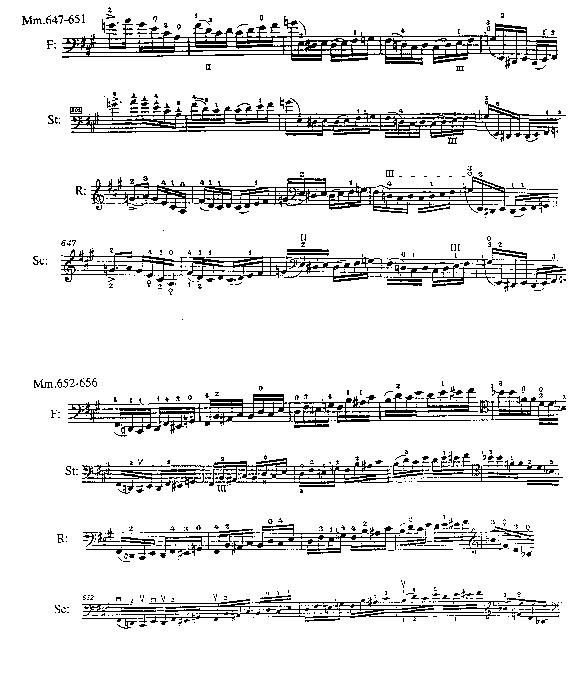
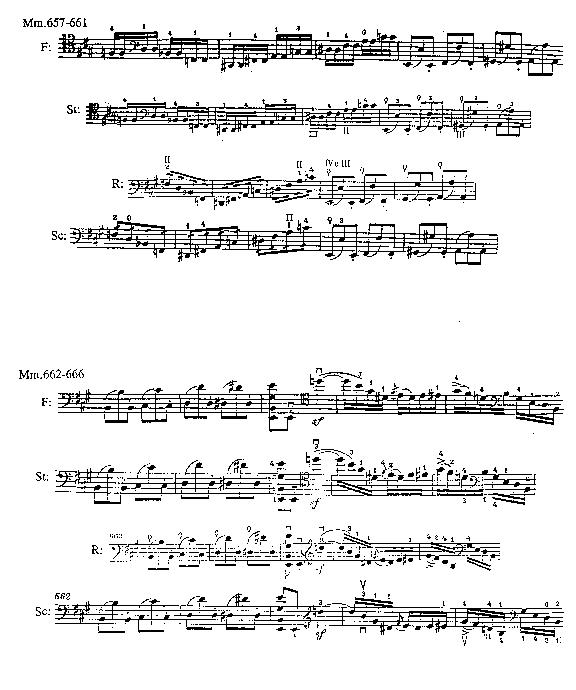
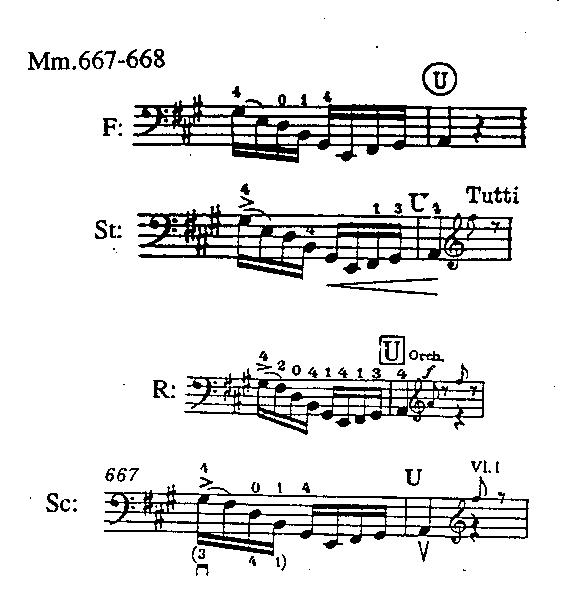
whereas Schiff uses 3 for m.633 and Schiff and Rose both use 2 for the last 16th of m.637. Here we again see Schiff and Rose making larger shifts to avoid playing the fourth finger, while Feuermann prefers to play the fourth finger and make the smaller shift. In mm.644-646, Feuermann uses a basic first position fingering with extensions (as does Stutschewsky) while Rose and Schiff use a third position fingering requiring less extension.
Only the Rose bowings differ significantly in mm.630-647, with Rose making four consecutive down-bows in mm.638-642 and hooking the dotted eighth/sixteenth note figures in mm.635 and 642-647. Aside from this, and Schiff's non-slurring of the first two 16ths on the first and third beats of m.665, all the editors bowings are similar. In fact, apart from these small exceptions, the editors bowings agree throughout this entire excerpt, which may speak more to the limited practical bowing options that are available for this rapid repetitive passage work than to the editors' uniformity in bowing philosophy.
Feuermann plays mm.647-648 in a single thumb position without shifting, switching to the D string for most of m.648, while the others choose to remain in more traditional positions on the A string, shifting as necessary. In m.650, Feuermann (and Stutschewsky) take a fairly simple fingering, making only one shift on the fourth beat. Rose makes a shift on the second sixteenth of the third beat, and then requires another shift to the down-beat of m.651. Schiff plays an open D instead of fourth finger on the second 16th, and then moves from the open D to 1st finger on the C#. While this somewhat larger shift is simplified by moving from the open string, it does seem to again represent a certain preference of Schiff's to make larger shifts in order to play notes with the first or second finger rather than the third or fourth. In m.652, Feuermann makes three small shifts on each of the first three beats while the others make two somewhat larger shifts on the weak halves of the first and third beat. In m.656, Rose (and also Schiff apparently) remain in the same position. While this alleviates the need for a shift in this measure, it creates a very large shift from thumb to 2 on the down-beat of the next measure. Stutschewsky avoids the thumb position altogether, making two shifts and then playing the down-beat of m.657 on the G string. Feuermann, however, avoids Stutschewsky's first shift by using the thumb, and then shifts on the fourth beat so that he can also play the following down-beat in the same position on the G string. Furthermore, he simplifies the execution of this slide by playing a harmonic on the preceding note. Feuermann thus avoids the large and potentially difficult shift of the Rose and Schiff editions, but also avoids the extra shift of Stutschewsky's fingering.
While Feuermann's fingering indication in m.659 is clearly different from that of the other editors, it is not sufficiently marked to allow certainty as to which fingering is implied. The similarity between the editions in the next several measures is quite striking, though we again can not be certain of Feuermann's fingerings for the octaves without an indication. Only in m.667 do they editions diverge. Here the Feuermann and Stutschewsky editions have a different note on the second 16th note -E instead of F#. This necessitates a different fingering, naturally, and in the subsequent notes, Feuermann and Schiff then choose the extension fingering 1-4 for the fourth and fifth 16th notes of the measure, while Rose and Stutschewsky shift into half position.
CONCLUSIONS
From this analysis many intriguing differences can be seen. Feuermann seems to tend to use smaller shifts and extensions where the others might make a larger shift. He tends to make fewer shifts and seems to prefer shifting on smaller intervals, particularly half steps. Feuermann also, to a somewhat greater extent than the others, creates opportunities to simplify shifts by shifting from an open string. In addition he often uses harmonics to simplify the shifting process.
Feuermann seems to take care to avoid shifting on notes where the accent created would be disruptive to the phrase, such as notes falling on the weak halves of beats or passing tones with small rhythmic values. Schiff and Rose often choose larger shifts in order to play exposed melodic notes with the first or second finger, whereas Feuermann (and to an extent Stutschewsky) are much less hesitant to play these notes with the third or fourth finger. Feuermann also does not avoid playing the open strings, particularly the A string, in exposed melodic situations to the same extent as the other editors. It also seems that Feuermann tends to stick with 'pattern' fingering in scale passages, i.e. 124 124 124 where another might finger 124 12 123 etc...
Feuermann seems to prefer to use slides which move from one half of the hand to the other, i.e. from 1 or 2 to 3 or 4, or vice versa. In particular, he often uses 3-1 for a descending slide (which is also associated with his typical small descending glissando.) The 1-4 ascending shift is another example of this favored type of shift. In general, of the possible shifting combinations, his preferences seem to run towards 1-3, 1-4, 2-1, 4-1 and 4-3 ascending and 1-2, 1-4, 3-1 and 3-2 descending. The 'rocking' motion of the left hand used to produce these shifts is similar (though reversed) between some of the favored ascending and descending shifts. For example, 1-3 ascending is in many ways essentially the mirror image of 3-1 descending, and many of his favored ascending and descending shifts are linked in this symmetry. Feuermann rarely makes ascending shifts into 2nd finger and also rarely into fourth finger, except 1-4 , which is fairly common.
With descending shifts, shifting into second finger is common, while shifts into fourth finger most often originate from the first finger. Descending shifts into the first finger are often done from third or fourth finger, and descending shifts into third finger are more rare, except when shifting 3-3 on the same finger. Feuermann also uses other same finger shifts, and uses the 1-1 ascending shift frequently, though rarely descending, and uses the 4-4 shift descending, though rarely ascending. The 2-2 shift is occasionally used, and the 3-3 is somewhat more common, both ascending and descending.
The other cellists often have similar preferences, but there are some differences. All three make more use of the 1-2 ascending shift than Feuermann, often for smaller, 'extension' type shifts, and they make less use of the ascending 1-4 shift. Stutschewsky is also notable for his heavy usage of the 2-2 ascending shift, which the others use much less. Stutschewsky and Schiff also make common use of the 2-2 descending shift, which Rose and Feuermann tend to avoid. All the cellists use the 3-1 descending shift often, but Stutschewsky also makes heavy use of 3-2 descending, which Feuermann an Schiff use more moderately and Rose uses very rarely. Schiff makes use of 3-4 descending shifts more often than the others, and tends to avoid the 4-4 descending shift that the others employ.
With respect to bowings, it is somewhat more difficult generalize about what distinguishes Feuermann's bowings from those of the other editors. Most importantly, Feuermann avoids bow changes on notes where the resulting accentuation would disturb the phrase, such as rhythmically weak or melodically inconsequential notes. He also seems to have had much less hesitation to play a heavily accented or climactic note on an up-bow and, along the same lines, felt less compulsion to always begin or end phrases with a down-bow. If one were to calculate the total number of bow changes in a section of these four editions, Stutschewsky would be seen to make the fewest and Rose the most, with Schiff closer to Stutschewsky and Feuermann closer to Rose, but this does not really yield a clear picture of the nature of these bowings. The details must truly be examined section by section, case by case, to be understood.
In the excerpts presented here it is probably Stutschewsky's choice of slurring that is closest to Feuermann's, though interestingly he sometimes played these identical slurrings with the reversed bowing (i.e. up-bow instead of down-bow) and he sometimes made longer slurs than Feuermann. The Rose edition generally seems to opt for more frequent breaks in the slurring in comparison to the Feuermann edition, while the Schiff edition seemed to be this most radically different in terms of general bowing and slurring preferences, but there is also much which the four editions have in common.
Overall the distinguishing characteristics of Feuermann's editions seem to be a somewhat simpler approach with regard to fingering, opting for more extensions and small shifts and fewer larger shifts, and an overall concern that shifts and bow changes not disturb a phrase by placing accentuations on notes which are rhythmically weak or otherwise lesser emphasized within the phrase. The simplicity and care to avoid disturbing the phrase which Feuermann shows in his performing editions are characteristics that are also very evident in his playing.
_________________
1 Robert Schumann, Concerto in A minor for ‘cello. Op. 129, ed. E. Feuermann (New York: Carl Fischer, 1939)
2 Luigi Boccherini, “Adagio and Allegro” from the Sonata No. 6 in A major, ed. E. Feuermann (New York: Carl Fischer, 1938)
3 W.A. Mozart, Concerto in D major, K.285d (formerly 314), trans. By G. Szell, ed. E. Feuermann (New York: G. Schirmer, 1941)
4 Robert Schumann, Concerto in A minor for ‘cello. Op. 129, ed. J. Stutschewsky (New York: International Music Company, c. 1940)
Robert Schumann, Concerto in A minor for ‘cello. Op. 129, ed. L. Rose (New York: International Music Company, 1960)
Robert Schumann, Concerto in A minor for ‘cello. Op. 129, ed. J. Draheim, solo part ed. H. Schiff (Leipzig: Breitkoph & Hartel, 1995)
5 Dates for this edition have not been located. 1940 represents a best guess, based on dates of other Stutschewsky editions.
6 Mosa Havivi remembers Feuermann playing this scale in a single bow in performance (p.133)
INTRODUCTION
Only one film of Emanuel Feuermann playing the cello is known to exist. Made between 1939 and 1940 for Artists Films, it is a short film, of approximately seven and a half minutes duration, in which Feuermann performs Dvorak's Rondo, Op. 94 and Popper's Spinning Song, Op. 55, #1, both with significant cuts. This film was produced as part of a series of educational films made for music appreciation classes in high schools and colleges, but was later combined with short films of other musicians to create a full length release entitled 'Adventure in Music' [1] . While Feuermann's film is unfortunately short, it does show his extraordinary abilities well, and provides an invaluable view of him playing the cello, showing details of his physical technique that could otherwise never be known.
Since the objective of the study is to find those features which distinguish Feuermann's approach from that of other cellists, it is useful to illuminate these distinctions by contrasting Feuermann's filmed performance with video performances of other cellists. We again consider Casals, Piatigorsky, Rostropovich and Ma, as they cover a broad spectrum of cello performance techniques and musical philosophies, and are the best known cellists of the century.
The particular performances used for this comparison include a film of Casals, of unknown origin, which appears to have been made in the late 40's or early 50's and contains performances of two unidentified works and his own arrangement of the native Catalonian folk song, Song of the Birds. Piatigorsky's performances were taken from a short film for which the original title and date are unavailable, but which has been re-released by Kultur on the videocassette entitled 'Heifetz/Piatigorsky'. Piatigorsky plays several short pieces in this film, which appears to date originally from the 1950's. The Rostropovich performance was viewed on a commercial videotape produced by Unitel, directed by Hugo Käch and copyright in 1976. On the video, Rostropovich performs the Haydn C and D major concerti with the Academy of St. Martin-in-the-Fields ensemble, which he also conducts. Ma's performance was taken from the 1993 Sony release 'Dvorak in Prague: A Celebration', in which he performs Dvorak's Silent Woods, Op. 68, No.5 with the Boston Symphony Orchestra, conducted by Seiji Ozawa and several other short works in conjunction with other artists.
There are some intrinsic limitations in this comparison, since it is impossible to compare the cellists performing the exact same works, and it is not possible to view the cellists from any angle other than those provided in each video, and, hence, not possible to view the cellists from exactly the same angle and distance. The comparison of the video taped performances does provide one advantage over live observation, however, as the viewer can watch each action of the cellists in slow motion, fast motion, frame by frame, as a still picture, or at normal speed, and the segments can be replayed as necessary until the viewer is satisfied with the detail of the observation.
The goal of this analysis is to note physical characteristics of Feuermann's technique that vary from those of the other cellists. Clearly there is much in the technical approach that all the cellists have in common and it would serve little purpose to discuss the basic techniques which Feuermann and all the others perform in the same manner. In addition, not all of the detail in a performer's technical approach can be discerned from observation, even when viewed at the slowest possible speed.
The physical act of playing the cello is accomplished by muscles acting in response to instructions from the players' brain. The technique of playing the cello is less about training our muscles to move in patterns than it is training our brain to instruct these muscles in the correct manner. It is not always possible, merely by observing the exterior physical motions of a player, to know exactly by what technique he accomplishes this motion. For example, when observing the shifting of the cellists, though differences are sometimes apparent, there are types of shifts in which the players seem to have a different mechanism, judging by the sound produced, but in which no major physical dissimilarities are seen. In part, this phenomenon may be due to the fact that many of the factors which affect the sound are not clearly physically observable, such as the amount of bow pressure and contact, the degree of left hand finger pressure and contact during shifts, and other similar small physical gradations which produce effect on the cello but do not necessarily require a readily apparent motion.
In addition, each of these cellists is different in body size and proportion, and often a technique of similar mechanism will look quite different when performed by another cellist with, for example, longer arms. The result of this is that not every characteristic which appears to be similar can necessarily be thought to be created by similar technique, and not all differences which are observable are necessarily the result of a differing technique. Nevertheless, there are differences between the cellists which are clearly the result of differing technical approaches, and they provide an interesting insight into their approaches.
The Feuermann video was produced in an unusual way, as the soundtrack was recorded separately from the film (presumably before.) Feuermann's playing in the film, while quite close, does not always agree exactly with the timing of the soundtrack, and certain camera shots were clearly made separately from the performance. In addition, in at least one section, in the Dvorak Rondo, a passage which is clearly heard to be played on the A string in the soundtrack is fingered on the D string by Feuermann on the film. Some previous commentators on this film have blamed the occasional minor timing differences on the soundtrack being improperly aligned with the film, but this seems not to be the entire story, as the synchronization is accurate in other sections. Despite these complications, Feuermann clearly is playing the instrument as if in concert during the filming, so despite their inconvenience, these problems do not seriously detract from the value of the film as an insight into Feuermann's playing style. It is also interesting to keep in mind Eva Feuermann Lehnsen's remark that, since her husband was made to remove his glasses during the filming and discouraged from his habit of sucking in his cheeks when he played, that he looks almost like 'a stranger' to her in the video.
The Casals tape appears to be taken from a live concert, while the Piatigorsky, Rostropovich and Ma tapes were professional productions, presumably made in a manner which is often typical for video recordings and 'live' performance recordings: The soundtrack and multiple video tracks are recorded at the same time in the original production and then any mistakes are corrected later by splicing onto that soundtrack.
We divide the comparison and analysis into three broad sections: The overall body position, including the head, legs and torso, the right hand and arm (bowing technique) and the left hand and arm (fingering technique).
OVERALL BODY POSITION
One of the first and most noticeable differences between the cellists is the differing heights at which they adjust their endpins, which consequently produces differing angles at which the cello intersects the torso and differing locations of the cello neck and scroll relative to the cellists head. Additional variables include the distinct body sizes of the performers and the slightly different proportions of the five different instruments. Feuermann's cello appears to make an angle of approximately 35° with his torso [2], with the end of the fingerboard slightly forward of and a few inches below his ear. Casals has the cello slightly more horizontal, making approximately a 45° angle with his torso, and the top end of the fingerboard and scroll are further back and much higher than with Feuermann. Piatigorsky holds the cello at about 40°, and the top of the cello falls somewhat higher than with Feuermann and somewhat lower than with Casals, but here one must also consider Piatigorsky's extreme height. Rostropovich holds the cello much more horizontally than any of the other cellists, at about 55°, and employs a special bent endpin to do so. The scroll is a little higher and further back in comparison to Feuermann. For Ma, the angle of the cello is average, about 43°, but the cello is held much further forward relative to his body, meaning that the cello seems to intersect his torso somewhat lower on his chest, and the scroll is much further forward than Feuermann's.
If the cello is assumed to be directly straight in front of the observer, than Feuermann's body is angled to the right (the observers left) about 35°, allowing him easy access to the entire cello with his bow arm. Almost all cellists turn in this manner, but the difference is in the degree. Casals makes a similar degree of turn as Feuermann, while Piatigorsky seems to make even slightly more so, but Rostropovich and Ma make a much smaller adjustment, making only a slight turn of the body. While Feuermann and Casals hold the cello so that it is perpendicular to the horizon (i.e. the image of the cello onto the two dimensional screen is vertical, when viewed from directly in front of the cello), Piatigorsky holds it in a manner that it is angled slightly, with the endpin slightly to the observers' lower left and the scroll to the observers' upper right. Rostropovich and Ma angle the cello in this way to a much greater extent, possibly necessary because of the smaller angle at which their torsos are turned to their celli.
Feuermann's' legs are positioned with his right leg forward and his left leg further back, a natural consequence of the angle of his torso to the instrument. The right knee holds the cello below the bout and the left touches the edge of the other bout in the fairly standard manner, and his lower legs are straight down, with the feet placed flat on the floor, though the left heel does raise once or twice in the film, when Feuermann rocks slightly to his right. Casals positioning of his legs and feet is similar, though he rocks his body somewhat more. Piatigorsky, because of his much longer legs, must angle his lower legs backwards but, as with Casals and Feuermann, the right leg and foot are in front of the left. Because of the much higher horizontal angle of Rostropovich's cello, his knees intersect the bouts much closer to the back of the cello. His legs angle back, though not because of their length as with Piatigorsky, and because of the smaller degree that he turns his torso, his feet are almost even behind the cello. Ma's legs are also angled back and again, because of his smaller turn towards the instrument, are also fairly even behind the cello.
Regardless of the angles of their torsos, all the cellists' heads face directly forward. Casals, Piatigorsky and Rostropovich make only occasional, limited motions with their heads, while Feuermann makes almost no motion at all, staring straight ahead in a manner that seems almost eerily disconnected. Given Eva Feuermann's comments and other photographs taken of him in performance, in which his face and head appear less rigid, this is presumably mainly an affectation for the camera, but the mere fact that he was capable of playing in this manner shows a high degree of ability to disassociate his neck and facial muscles from the mechanics of the lower body, and it seems likely that he did play with less head and facial motion than the other cellists. This idea is further reinforced by a famous photograph of Feuermann rehearsing with Heifetz and Rubinstein, in which he has a cigarette dangling from his mouth while playing. This feat (more difficult than one might think) requires a high degree a relaxation in the facial muscles and hence implies no sympathetic facial or neck muscle contractions while playing.
Ma provides an extreme contrast to the others, as he moves his head almost constantly, but it often seems to be more by choice than from involuntary sympathetic muscle contractions. Regardless of any judgments on the desirability of this type of affectation, this much larger degree of movement (which is typical of many contemporary players, not only Ma) brings to mind Sophie Feuermann's quoting of Isaac Stern's comment that with modern players "What they can't get out of their instruments, they attempt to get out of their bodies" [3]
RIGHT ARM AND BOWING
Feuermann's right arm is held in a fairly simple manner. Neither the elbow or wrist is raised, so there is the impression of a straight, smooth descending line. It may be that his shoulder is slightly raised, facilitating the relatively natural position of the wrist and elbow, but it is impossible to be sure from the film. Feuermann's arm is bent at the elbow, as is typical for cellists, but Feuermann maintains this bend throughout the bow, almost never allowing the arm to fully straighten. His wrist raises up and down during the course of up and down-bows, respectively. While the wrist rises gradually throughout the course of the up-bow, it often lowers immediately with the start of the down-bow. This raising and lowering of the wrist is active and noticeable, but never looks unnatural or extreme.
Casals' somewhat shorter bow arm looks quite similar in its general appearance, but straightens when Casals plays in the upper part of the bow. His elbow seems as if it might be slightly lower than Feuermann's and, while his wrist similarly rises up and down during the course of up and down-bows, the movement is somewhat larger than with Feuermann. With Casals, the wrist movement is always after the bow change, during the course of the bow, and not directly on the down-bow change as was often the case with Feuermann.
Piatigorsky's longer arms necessitate more of a bend in his elbow, and the elbow seems slightly lower than Feuermann's, consequently making the wrist seem higher. Whether this is the result of Piatigorsky's shoulder also being slightly lower, as it seems it might, is impossible to say with certainty. Like Casals, Piatigorsky's bowing divides the arm motion in two parts, with the upper regions of the bow played by unbending the elbow and allowing the arm to become straighter. In his up-bow, his elbow dips slightly and his wrist raises, and the overall impression is that his bowing contains more wrist motion than Feuermann's. On his down-bow changes a type of 'kick' is sometimes seen, where the wrist moves first, pulling the fingers after it and momentarily changing their angle on position on the bow. While Feuermann also had a quick wrist motion, his fingers never changed their position holding the bow.
Rostropovich's arm position is, of course, affected by the higher angle of his cello, which means that his arm has less vertical distance in which to descend. Consequently his elbow is lower with respect to the rest of his arm than Feuermann's and, in fact, his entire arm seems somewhat lower and much more horizontal. His wrist seems almost level, with his hand lying in the same horizontal plane as his forearm. Unlike Feuermann, Rostropovich straightens his arm during the course of bowing, as do Casals and Piatigorsky. While his wrist does raise and lower during the course of the bow, it begins in a very flattened position, so by the time he reaches the tip of the bow, his wrist has lowered so much that it is almost at a lower level than his fingers. His bow change involves a similar, but much larger, 'kick', than was described with Piatigorsky, with Rostropovich's entire hand and fingers jerking backwards on the change to a down-bow. This could possibly be an indication that he holds the bow rather loosely with the fingers.
Though Ma's shoulder seems somewhat lower than Feuermann's, his elbow seems relatively higher and his body position, holding the cello further forward, necessitates his whole arm being somewhat higher. His wrist is held high, and lowers only at the tip of the bow, returning to a high position during the up-bow more quickly than with Feuermann. His basic arm motion is strongly in two parts, with a larger portion of the bow played by straightening forearm than with the Piatigorsky, Casals or Rostropovich. With Ma, the 'kick' of the bow change, causing the fingers to reposition is evident not only on the down-bows, but also sometimes on the up-bows.
Feuermann's hand position on the bow remains quite constant throughout the course of he bow. His fingers descend almost directly downwards, with relatively small bends in the knuckles. The hand is turned slightly forward, though often the fingers are quite close to vertical. The first finger [4] is the most curved and also leans forward the most, curling just slightly under the stick below the lowest joint, where it intersects the bow. Separated from the first by a small gap, the second finger is only slightly curled, and its tip reaches just above the hair at, or just slightly forward of, the metal where the hair joins the frog of the bow. The third finger is straighter, almost touching the second and reaching slightly lower, to the bottom of the frog. The fourth finger is slightly more separated from the third than the second and third are from each other, and is much higher on the frog, with the tip near the intersection of the stick and the frog. The third, and especially the fourth fingers, seem to contact the frog more lightly than the first two, and the strongest contact seems to come from the first finger. The fourth finger occasionally lifts from the bow, particularly in staccato and spiccato passages. Most surprising, Feuermann's thumb is straight, almost bending inward as it pushes against the frog. This unorthodox method is in direct contradiction with the technique of almost every modern cellist (with the notable exception of Zara Nelsova.)
Casals bow grip is more variable, changing more during the course of the bowing. The angle of his fingers with his hand is less, as his fingers more rounded. Compared to Feuermann, his somewhat shorter fingers are more tightly bunched as a group and are slightly lower on the bow and frog. The hand is somewhat less turned towards the tip than Feuermann's, and the bow is held slightly further forward on the frog. His fourth finger occasionally loses contact with the stick, but so also do the second and third at different times, and the overall impression is of a greater degree of movement in the hand and finger positions during the bowing.
Piatigorsky's hand is angled very forward towards the tip, and his grip on the bow is also further forward, with the third finger on the metal of the frog. His fingers are slightly more rounded and hence the angle of the first segment of the finger to the hand is slightly flatter than with Feuermann. As mentioned, Piatigorsky's fingers briefly change position on the down-bow change, as if the wrist were dragging the fingers backwards, changing their angle and grip on the bow. The original position is quickly regained, however.
Rostropovich's hand position is radically different from Feuermann's, probably resulting in part from the high angle of his cello. With the strings and consequently the bow at a much higher level, the first joints of Rostropovich's fingers are almost flat with the hand, which is in turn flat with the wrist. The overall effect appears almost as if the arm were hanging on the bow, which seems as if it might be advantageous for applying a large amount of downward pressure to the bow, but seems also to be potentially more restrictive of movement. Rostropovich grips the bow with his fingers bunched together, directly vertical. The grip is forward on the bow, with the third finger near the metal, but the fingers are quite low, so the tip of the third finger is actually below the frog. It looks as if the fingers might grip the bow loosely, since the fingers move a great deal during bow changes, jerking backwards during down-bow changes to a much greater degree than with Piatigorsky and returning to their original positions more slowly. As with the other cellists, the fourth finger occasionally loses contact with the stick.
Ma's fingers are also quite rounded in his bow grip in comparison with Feuermann's, and hence the upper segment of his fingers are more level with his hand. He grips the bow with the third finger on the metal, further forward on the frog than Feuermann, and also grips it somewhat higher on the frog. There are relatively large gaps between his first and second fingers and between his third and fourth fingers, and his fingers change position and readjust frequently during the course of bowing. His fingers tend to curl during the down-bow, changing the relative angles of the hand and wrist, and 'jump' on both up and down-bow changes, changing position on the frog. Like the others, his fourth finger occasionally loses contact with the stick.
Other aspects of bowing technique, such as bow angles and bow distribution, are not discussed here as either the cellists techniques seemed generally similar or the differences were not easily detectable. Despite this elaboration of their technical differences, there is also much in their right arm technique that all these cellists share in common. The factors which seem to clearly differentiate Feuermann, however, are his use of the arm as a 'single unit' -not straightening the arm in the upper half of the bow, his less extreme movement of the wrist up and down, the fact that he does not allow his fingers to change position on the bow in reaction to the movement of the wrist during the bow changes -in particular, down-bow changes, his hand position -slightly further back on the bow, with his second finger on the metal where the others generally place their third, and his straight thumb .
LEFT HAND AND ARM
The position of the cellists' left arms is influenced not only by the length of their respective arms, but by the height of their cellos. The left arm must naturally be held somewhat higher by all the cellists when they move into thumb position. Feuermann holds his arm at an approximate 45° degree angle down from horizontal in the lower positions, moving to about a 35° angle in thumb position. His wrist is slightly bent in (downward) in the lower positions, creating an angle rather than a straight line between the forearm and hand. Casals must hold his arm somewhat higher than Feuermann in thumb position, as his arm is shorter and his cello slightly higher. In addition, his wrist is somewhat less bent in the lower positions. Piatigorsky's longer arm is held somewhat higher, and his wrist is straight in the lower positions, and Rostropovich's arm is held in a similar manner, with very little bending of the wrist, higher than Feuermann's. In thumb position, because of the much higher angle of his cello, Rostropovich's arm is virtually horizontal. Ma's overall arm position is also similar, but because he holds the cello more forward and his arms are shorter than Feuermann's, his arm is also more horizontal in the thumb positions.
Feuermann's typical hand position is angled somewhat back towards the nut of the fingerboard in both the vertical and horizontal planes of the fingerboard, and this angling is even more pronounced in the thumb positions. Feuermann's fourth finger occasionally is held away form the other fingers, off the side of the fingerboard and curled, and his third finger sometimes extends straight, especially while held over the fingerboard while the second finger plays. Often when playing the second finger, the third will move together with the second as the second depresses and similarly, the fourth will move with the third when it depresses. This is especially clear on Feuermann's trills, where the upper finger of the trill and its higher neighbor seem to move as a unit. In thumb position, Feuermann's thumb bends back slightly, except when playing octaves, and is held at a small distance from the other fingers. When his hand position is extended, Feuermann has larger gaps between his first and second fingers and his third and fourth, and less space between his second and third.
A crucial difference between Feuermann and the other cellists is that he keeps the hand extended only when required for the upcoming note or shift, and otherwise returns the hand to the 'natural' unextended position, with the fingers together and the hand angled back (in the vertical plane of the fingerboard) towards the pegs. While many of the technical differences that we discuss here are relatively minor and often the result of different physical or instrumental setup rather than different technical methods, this is one clear example of a significant difference between the cellists. Feuermann's hand only extends just before certain shifts or before playing a rapid passage requiring extensions, and it is returned to the 'natural' position whenever possible.
Feuermann's fingers strike from high above the string, especially the third and fourth finger, which are held high when the first finger is played in the 'natural' hand position, with the hand rotating on the axis of the first finger in the lower positions and the thumb in the higher positions. In the rapid fire fingering of the Elfentanz, the action of the fingers striking from above and then immediately rebounding seems almost like the action of piano hammers. Interestingly, Suzette Forgues quotes Feuermann's philosophy of finger action using this same analogy [5]
Casals' fingers are more evenly spaced and somewhat less angled than Feuermann's, and his extensions are more deliberate and held longer than Feuermann's, including the extensions that are involved in the preparation for certain types of shifts. Though Casals' natural finger spacing is somewhat wider and more evenly spaced than Feuermann's, his left hand technique looks the closest to Feuermann's of the four cellists used for comparison. Casals' fourth finger is lifted away from the fingerboard somewhat more frequently than with Feuermann, and his first finger also lifts away occasionally.
Piatigorsky's large hand seems to be more rounded in the lower positions, with the thumb and fingers forming a circle, connecting at the fingerboard. In contrast, Feuermann appears to hold his thumb much straighter underneath the neck in the lower positions and, at least part of the time, his thumb is actually bent backwards against the neck of the cello. Piatigorsky's hand seems to have even more backwards angle (towards the top of the fingerboard, in the horizontal plane of the fingerboard) than Feuermann's, almost taking the appearance of a violinist's hand position, but for Piatigorsky there is no 'natural' position to which the hand consistently returns. Instead there is a slightly different hand position for each finger as it plays, at least during sustained notes. In thumb position, Piatigorsky's thumb is held closer to the other fingers than Feuermann's and is straighter. Like Casals, his fourth finger also sometimes comes away from the fingerboard, and his first finger also often lifts high above the fingerboard.
Rostropovich's hand seems perhaps slightly more angled back than Feuermann's, but less so than Piatigorsky's and, as with Piatigorsky and Casals, there is no 'natural' position, but a somewhat different hand position for each finger. This difference is, of course, mainly noticeable only on slow, sustained notes and it seems to relate to the vibrato motion, as we will discuss further. The one trait of Rostropovich's which is strikingly distinct from Feuermann, Casals and Piatigorsky is that he occasionally allows his fingers to collapse at the third (lowest) knuckle.
If Feuermann's hand positions appear to be the simplest, constantly using the same positions and motions, Ma's appear the most complicated. In the lower positions his hand is quite square (perpendicular) to the cello, but in the thumb positions it is very much angled backwards (towards the top of the cello.) The thumb is much looser in both the upper and lower positions, frequently coming out from behind the neck or even off the fingerboard in thumb positions. Ma's fingers collapse in the same manner as Rostropovich's, but much more frequently, and his hand position seems to change frequently, with different fingers lifting above the rest and fingers alternately spaced apart or bunched very tightly, the second actually overlapping on top of the first in some instances.
While the cellists hand positions demonstrate a variety of approaches, the differences which are most noticeable and significant seem to stem from the cellists different physical approach to vibrato. Feuermann's vibrato seems very much produced by a 'whole hand' motion. While the fingers besides the one stopping the string are raised off the string, they come up only slightly and remain close to each other in the 'natural' Feuermann hand position. When Feuermann vibrates in thumb position, the thumb is not pressed down into the string but remains on top of the string, making light contact.
With Casals and Piatigorsky, one is much more aware of the individual fingers in the vibrato motion, as the other fingers are sometimes lifted away, and the appearance is that the vibrato is produced more by moving a particular finger than by moving the hand as a unit. For example, when Piatigorsky vibrates on the second or third finger, he tends to lift the first finger quite high and vibrates with a wide rocking motion, so that the hand 'teeter-totters' over the vibrated finger.
Rostropovich's vibrato is visibly wider than Feuermann's. When vibrating on the first finger, the second actually overlaps on top of the first, while the third and fourth are raised above, but when vibrating on the other fingers, it is really only the vibrating finger which acts alone, while the others are often lifted quite high , even pointing away from the hand in various directions. As noted before, Rostropovich occasionally collapses his fingers at the lowest knuckle, which would naturally change the sound of the vibrato being produced, and the large number of notes with no vibrato also lends a somewhat 'jerky' impression of the hand's movement when compared to the nearly constant vibrato motion of Feuermann.
Ma's vibrato motion is also visibly wider and can often be seen to start significantly after the note has begun to sound. Ma's hand position for the vibrato varies widely, depending on which finger is vibrated. When the first finger is vibrated, the other fingers are tightly bunched up above it, with the second finger overlapped on top of the first, but when vibrating the second and third fingers, the first and fourth are lifted high. When vibrating the fourth finger, all the other fingers are raised, with significant spacing between them. When vibrating in the lower positions, Ma's thumb can sometimes be seen coming out from behind the neck, particularly in the fourth position and, in all positions, his fingers are frequently collapsed at the third knuckle, more often than Rostropovich's. In thumb position, the large backward angle of Ma's hand position (which contrasts with his nearly perpendicular position in the lower positions) creates a vibrato motion that is almost more side to side on the string than up and down, and this effect is further increased when he raises the thumb away from the strings, as he occasionally does in the thumb position, pointing it perpendicularly back from his hand and upwards.
As with the right arm, other elements of the cellists motion that would seem interesting, such as shifting motion, were either too similar to merit discussion or impossible to discern from the videotaped performances. The most striking feature of left hand technique which distinguishes Feuermann is the simpler appearance of his motions, keeping the hand in a natural, unextended position whenever possible and vibrating almost constantly in a motion which involves the whole hand. It would be inaccurate, however, to say that Feuermann's hand looks 'relaxed.' The most accurate description would probably be to say that his hand looked 'tight' but never awkward or strained.
Casals and Piatigorsky's motions look somewhat more complicated, with the hand more often stretched or extended, and the vibrato motion and hand position varying, depending on which finger was vibrated. Rostropovich's and, especially, Ma's hands look much more complex, as there is a frequent alternation between notes with wide vibrato and notes with none, more extreme hand position changes, more lifting of the other fingers during vibrato on one particular finger, and periodic collapsing of the fingers. That this relative degree of complication in motion corresponds to these latter cellists' relatively more complex and sporadic interpretations (as detailed in the earlier comparison of recordings chapter) seems more than coincidental, particularly in the case of the vibrato motion, which translates directly into an audible result. It is purely speculation, but it seems as if the wider, more complicated vibrato hand positions and motions of Rostropovich and Ma may result from an attempt to increase the degree of musical intensity of a note by increasing the intensity of the actual physical motion.
CONCLUSION
The most striking differences between Feuermann and the other cellists are Feuermann's somewhat greater angling of the body to the right side of the cello, his rarely straightening his right arm, his more constant right hand position on the bow -not moving much even during bow changes, his holding the bow slightly further back towards the frog, with the second finger near the metal band on the frog, and his straight thumb. With Feuermann's left hand, the major differences are his consistent vibrato usage, usually produced with the hand in the 'natural' position, the fingers close but not tightly bunched, his never remaining in an extended position longer than necessary, and the high striking action of his fingers, with much of the striking impulse seeming to come from the arm rather than the individual finger.
This analysis actually only scratches the surface of what can be learned from these films. Only the most obvious differences are discussed here -necessarily in broad generalities- and the comparisons must make many generalizations. The correspondence between the physical motions of the cellists and their interpretive differences is most noticeable in the case of vibrato, where the clearly observable physical motion directly translates into the sound produced, but what are also striking are the ways in which all the cellists, whose playing is so different to the ear, seem to play similarly physically, with many of their differences explainable by their different body sizes and cello heights. As young cellists we are taught to play the cello by being instructed as to what physical motions we should make -'put this finger here', 'move your shoulder so', 'shift with this type of motion'- and this type of instruction continues even into the highest levels of conservatory training, with students consistently being given the impression that if they will only hold the bow in a certain way or shift with the same motion as their teacher, that all their problems will be solved.
While some physical techniques and motions clearly hinder a cellist, and correcting them would obviously be beneficial, the fact that these five cellists produce such different results, using techniques that in many ways appear very similar, points out the limitation in this approach. One can not start with the 'correct' physical motion and expect, therefore, to produce good cello playing. If one starts, however, by attempting to produce the desired sound and effect, the correct physical technique to do so will inevitably be discovered. How much of our learning is wasted by concentrating on reproducing the methods by which another cellist achieves a result, instead of the actual result? For this reason, we can not take those physical motions in Feuermann's technique which are different from the other cellists' and assume that they are the answer to the question of how Feuermann played. The most significant differences in Feuermann's technique are the things that can be heard -the unique features of his performance that we discussed in the comparison of recordings chapter.
While it has personally been helpful to me to emulate some of Feuermann's physical methods, and I hope that it will be for other readers as well, we must still remember Feuermann's teaching -his repeated rejection of Suzette Forgues' first notes of the Haydn concerto without ever explaining what was wrong, until she finally heard it for herself. The process of learning and correction must begin from the ears, rather than the body. The most important thing that can be learned from studying Feuermann is not how to merely imitate Feuermann, but how to listen and analyze as he did, and only by reaching this level of awareness can we begin to emulate his standards of technique and musicianship, and finally allow the cello to realize its full potential.
_________________________________
1 Jon Samuels, “A Complete Discography of the Recordings of Emanuel Feuermann,” ARSC Journal 12, no. 1-3 (1980): p.67
2 Angle measurements are subject to the distortion of the visual recording and playback systems, and are therefore not absolute measurements, but given as a basis of comparison between the cellists. The actual angles should, however, be within a relatively small margin of error from the playback measurements.
3 P. 145
4 Here we use the same numbering system as with the left-hand of the cello: index finger=first finger; pinky=fourth finger, etc.
5 P. 116
Suzette Forgues Halasz studied with Feuermann from his arrival in America in 1938 until his death in 1942, in both New York and California. She is married to the conductor Laszlo Halasz, but is herein referred to by her maiden name for ease of reference.
Q: Nobody ever talks about how, or why, or the whole approach to the music...
A: The last when he was very sick, I was the last one to go to his house in Rye, but he wrote to his wife. He said "this has to stop. I'm too far away from everything, I'm always on tour, one after the other. I hear all these cellists and they don't know anything-they're supposed to be top cellists-they're first cellists-they don't know anything." He said "I think I have to stop this and I will teach". Now that would have been great for everybody. He did teach for one year I think, at Curtis. I remember that he had said, when I was I think 16 and I was in awe -I was playing on the radio little things just to make money and so on and I came directly to go hear him in the afternoon there was called the Ladies Morning Musical club and he had been in the papers and I thought 'Oh well I was auxiliary so that means you didn't pay as much because you were young' -you could go and hear him. But I had the cello with me -I didn't know where to leave it- so I was in the back and then I started listening to him and I never heard -and not knowing so much about cello- I was too young in a way- but I was so fascinated that even if I was shy I went in backstage, I waited. It was crowded, I waited and waited till my turn. Finally he sees me there with the cello says "So you're a cellist...would you like to play for me". I almost dropped the cello and I said "well, yes, I would like to". He said "well why don't you come tomorrow at my hotel and you play for me" So I went home practically flying -I was so excited and I told my mother and she said "Now don't get so excited-these great people they forget things, they say things, you haven't got a chance probably" She didn't want me to be hurt. The next day comes, and of course she comes with me -she is my chaperone...and then I played the Tarantella -Popper. He stopped me -two bars or three bars and I was showing off. I thought I was good -you know- fast. And he said -he couldn't speak English too much and he said "You play like a pig" and I -my breath left me- and I thought 'Oh my goodness' you know, and he said "I don't speak English good so that means -you know that a pig is not clean, right?" and I said "Yes of course." "You don't play clean. There is a difference between your fourth and first finger in first position (of course I know that by now) then in fourth [Sings opening of Popper Tarantella], so the interval is smaller because you are in fourth position." Nobody ever told me that. You think of fingerings and you go like mad and your teacher thinks you are great. You don't know anything. Then he says to my mother after I played some more "Why isn't this child in Europe? She should be in Paris" ...My mother, she said "She's only 16 -it's not possible. She can not be there alone" and all this. "Did these people hear her, where I played yesterday?" My mother said no. "Well why not?" "Well, Nobody asked her." He said " I will tell them to hear her. Then they will hear her and then they will give her a scholarship and then I will give her a scholarship. She can come to New York". Well, you could open the floor, I would go right through it. I couldn't believe this, you know. Yes -the next day the ladies call me- "Would you come and play for us?" So I played and I got $400, which in those days was a lot of money, of course. Then I got very excited and very happy. I come to New York, he is not there. I didn't know what to do. So I heard that Felix Salmond was a very fine teacher. I went to Juilliard and asked to play for him. I played but I had no money, because there was $30 a lesson and I had only $400. I want to be very careful. He said "All right...you can come to me but it will be an audition every time" So I didn't have to pay, but he didn't want to say it that -you know. So for a few months, that's what I did. Feuermann came back from Japan -somewhere- so obviously I went to play for him and he said "What have you been doing?" "Well," I said "Mr. Feuermann, you weren't here, so I didn't know what to do. I went to play for Felix Salmond." "You should have stayed home and practiced. You would have done better." He didn't like him. I was crushed, but I didn't know what to do. He said "Well, we'll see about that. You start coming next week" So that's how I started, and one thing led to another and then I ran out of money, of course. I got another scholarship, came back again, ran out of money again. So the third scholarship -after that they told me "You can't try again because you always win, it's not fair for the others" So Feuermann came to Canada again, so I told him I don't have the money to go back. "Don't worry about it. I'll write to the government" -Oh I forgot to tell you- there was only one scholarship left and that was a government scholarship -everybody under 21 could try. Every year just only one. But it's not only for cellists-it's for everybody... And that's how I could get back to New York, you see. And then with Feuermann -I'm told by the Ohio Feuermann society that I was the only scholarship pupil, but I don't know how true that is- but anyway, the fact that I had the chance to play for him. You know he was my god, I mean he was the greatest and the Feuermann pupils -I don't know about others, but if you'd play somewhere, somebody was coming backstage and saying "You must be a Feuermann pupil. You play differently." I don't know what it was. They recognized it every time. So you know you sort of felt pretty smart. That on your shoulder you felt rather big shot, but you tried very hard and he was a very difficult, demanding teacher. He would... I remember for one hour I had the three first notes of the second movement of Haydn [D major Concerto]. "No!" And you're scared so you try again. "No!" He would hit your bow. "No!" But he never told you how, so you try again. You try to think 'what does he want?' and you try again. Finally he said "Go home and practice." After three notes. I felt like going up on the Empire State, throwing the cello and jumping after it. I felt that bad. But then I woke up very angry with myself -if you can't take it, don't go. And I practiced and I practiced and I finally went there back again. He almost threw me out, because I was so scared and when I start my bow just jumped on the string. He said "Do it again." And I thought 'If I don't do it, I give up'. Then it went, and he said "So..." So why couldn't he explain it to me first? I wouldn't have gone into so much anxiety. But you know one thing? Since years and years, I know why. He made you think. I remember one lesson in California. We had had lunch, I was sort of a favored youngsters and he said "Now it's time for a siesta." I said " I don't take siestas." "You take siesta. You go up a take a siesta." I mean you know you don't say no. Then after that I had the lesson he said " Now you go up in my other studio up there and you write everything I said, and don't come down until it's all there." So I...you know it was a long lesson and you had everything to write. He'd come and open so -"Well?" "No, I'm not ready yet." And then I really worked over this and I wrote everything I could remember and it was OK with him, but then, again -he made me think. And I thought it was plain torture in those days. I thought he was doing it out of meanness, because he was a very sarcastic man and if you couldn't take it you shouldn't be there. One day I came and I was the second one in the morning and there was a young man playing -first cellist, I don't know where in San Francisco, but from there. And there was a lot of yelling from Feuermann and I thought 'Ooh' you know, 'he's in a bad mood' and I sneaked in the entrance and he heard. He said "Suzette." I said "Yes." He said "Come in." I said "Maybe I should wait out here." "Come in" and I though I'd be embarrassing this fellow so I didn't want to. I went in and I sat in the back as far as the living room permitted and he was continuing. He said "All you know is schmaltz, schmaltz, schmaltz! That's all you know. If you come in the morning, you ruin my day. If you come in the evening, you ruin my night." He said "That's all you know, schmaltz" He said, "Get out of here! Go back to San Francisco. Good enough for you. Get Out. Out, Out, Out!" Then he turned around and he said "Come. Play" and I thought 'after this?' But I'd been to good school. I had a teacher -Belgian- in Canada who was very difficult. When he was yelling I thought the windows were shaking. Red with the white hair -I thought he'd die of apoplexy...But that's the way it was. So I sit there and I didn't know what's coming to me. He said "So. Can you schmaltz too?" I said "Of course, Mr. Feuermann, if that's what you wish" Then he sort of half-smiled and he said "All right. Play" ... It hurt very much when there was a group, because he was sarcastic. He was tense, and he'd do it not out of meanness -because he was right in many ways- but he sort of made it difficult to accept, especially when you didn't play his way. And I remember one day -I don't know, but it wasn't my day and he was not happy with me and there were four other cellists, unfortunately, waiting for their turn and also and they didn't like that I get this hell from him and they'd understand everything, so I switched to French and he switched to French -he didn't notice. And the others were stuck -they couldn't hear a thing he said. Then there was [Jens Guslebas?] -and she became assistant 1st of Chicago afterwards- and it was her turn. She was also rather tense. She didn't know what to expect. No one ever did anyway. And she got into trouble too. He was showing off for the others. So she figured out a way -she spoke Dutch to him. To my amazement, he answered in Dutch and he went on like this and here we were -we didn't understand a thing what's going on. You see? It was very strange and if you were alone or if you were in very few people that was fine, but a larger gathering he became sarcastic. It was difficult to accept. I remember one thing. I was a very good ping-pong player in those days and I remember his sarcasm. One day I was having a lesson and Schuster -a cello teacher rather well known in those days -an older gentleman- came to visit and he said "Come, I want you to hear one of my pupils" and that was the opening of the Boellman Variations, it's in the same bow and he wanted to show how I could do that and how fast I could trill -this sort of thing. He was, again, showing what his student could do. And he said "You know, she's very good... She's a very good ping-pong player." ...So one day he said "Heifetz plays fantastic" he said "plays fantastic ping-pong. You teach me." He said "After the lesson, we go to the ping-pong table. You teach me how do you smash these balls?" And I remember that I being so excitable person, when I played for him he said "Don't get so excited. Wait. Wait before the glissando. You're too excited. Just wait." All right. So one day, he wanted to smash a ball and I said "All right, Mr. Feuermann, this is you turn your body this way." and I was showing how to do it and then it hits the corner. "I know, I know, I know" he says. He wants to try. "Fine. I will throw you a very easy one and you just turn and do this." So I do that and he hits the ball at full speed in the net, of course and I couldn't help it -it was the first time that I did this- I said "Tch,tch,tch Mr. Feuermann, you mustn't get so excited. You must wait before you hit the ball" He chased me out of the house all the way down to my place. We had a great time. It was the best summer I ever, ever had in my life because of him.
Q: That was in California?
A: Everybody went to California, I mean the ones he accepted. But there was Bobby LaMarchina...Fantastic youngster. He was the youngest. We were in awe how he played. Really very well...
Q: What were the things he would most often criticize in lessons?
A: Bow and finger together.
Q: The coordination?
A: It has to be coordinated. It has to be synchronized. He didn't have words to explain so he made you search for everything, which I think in a way was hard, but as you became a teacher, you're able to think more and I've that big mirror downstairs and...when I had a chance to play by myself I'd watch and say 'Why does this sound so good? What am I doing?' I do it over again -'ahh' and I'd find out. Then I would be able to translate what I did to the next student. And I sort of learned by myself what to do with what he wanted and what he expected, because it had to be his way. When you did very well, you know, his left hand -he never knew and I never told him- his left hand would start to vibrato on his thigh and I would think 'Oh, he really likes it. This is what he wants', so you felt wonderful. In those days you flew out of there and you could be on a cloud of happiness. But he was very demanding and he wouldn't let one thing go by. The shifts had to be perfect. Again, the bow and the movement of the body going into it. He would not explain, but I know very well from teaching that if you're a little bit tense here or here -that's why he was playing this way [sucks in cheeks]. We all imitated him when he didn't look, but he'd bring his cheeks in. He couldn't play any other way. I don't why, but maybe it opened his jaw. I don't know because I never dared to ask him, but I know from experience teaching from young to older that the moment you tense either there or here your sound is not the same. He has the most beautiful sound. Even though with the bad records, you still hear it. Alive, you know, singing. You know what he liked? Caruso records. He was collecting them. And I remember whenever I had the chance to go in a little old shop. I'd look, hunt for one that he might not have and bring him one. That was my pleasure. The bel canto that you hear in a top tenor like him, he listened and I'm sure he applied it. People say that he -as you probably heard- that he never practiced. I never heard him practice either. I know for a fact in those trios of Rubinstein, Heifetz...Well, they were in California at that summer and I remember one day he insisted on the ping-pong teaching. You know I got even with him a few times. It was a pleasure. So Eva came out the door and she said "Suzette, let him go, let him go. He has to make recordings. He's going to be late." I said "Let him go? He does what he wants." He said "Leave us alone. I'm studying this. I have to learn what she's doing." "But Munio, please! Heifetz and Rubinstein... They are waiting!" "OK, I'll be there soon." " Play, play, play some more" he would say to me. I remember one boy, his name was Kramer, I don't know if he is alive, I haven't heard from him...He might come in the same suit every lesson and he practiced very -we all did. If you walked in Santa Monica above where we lived in Pacific Palisades -I found a places for everybody- so you walk at night, everybody's practicing like crazy. I remember that I lived with this old lady, and she had given me a room on the second floor and there was a balcony. And one day I was practicing as much as I could and I had a strange feeling. I stopped practicing, I went on the balcony. Feuermann, who loved his Buick...convertible. He was sitting in there listening to me practice. And then he saw me and he said "Come. I've decided you have a lesson today" "But Mr. Feuermann I'm not ready" "I don't care. Just come. Right now" ...So ready or not he expected you to play when he was ready to hear you like this. Otherwise you had your lesson pretty much, except if he went away. So you had to practice those few weeks he was on tour. An extraordinary man. I remember at lunch once he was trying to be very correct about his English pronunciation and I said something about 20 hours he says "twenty, not twony." My English wasn't great either, but he was right. He liked to be right...What a wonderful person. What a great artist... [Talking about Feuermann's appointment at 16 as professor] Well he could teach almost anyone. You know people, violinists, violists, bass players went to him. It was all the same idea, no matter if it was this or if it was this position, they learned from him. Who was this well known violist who used to go to him?...Katims. He went, and then there was another one. But, anyone could learn music from him, as you probably heard on the tapes. They had discussions about musical problems and he always won out because he was always right. [referring to a Szymon Goldberg quote from an interview by Monica Feuermann] I think there's no other genius. Everybody plays beautiful cello, but not like him. Do you know anybody who plays like that? No.
Q: It's headed in the opposite direction, I think
A: That's why he wanted to teach so badly, and he died...
Q: What do you think people do differently than his style of playing now?
A; Well, first of all, nobody's learning anything from anyone. As long as they play fast, as long as they play all the notes they're not... He made music as well. Now, he always picked the strings when he...You see there was bravura in Feuermann's playing and this picking of string...[when she was talking to a student of hers, she said] "I never showed you that you go back with the fourth finger and you slide back. Why do you do that? I told you, every note is like piano. You don't want this schmaltz in between"-that's the word he was using. So it was like pearls, it has to be every note going up or down has to sound the same, besides the point. If you have to shift , that's different. If you have a big glissando, you sit on that note before. Sit there. Don't anticipate. Relax...Little details like this which I picked up and I remember everything quite well even though I didn't write everything, except that day -but it has to be clean playing. It has to sing. The bow has to be changing together with the finger. Like you know the sports car when you change? If not you have this 'crccchht' kind of sound. He loved cars, by the way, but he didn't have a shift. He used to take me back to the station showing off a little bit in his ...convertible. And coming down from his home there was this big 'S' going downwards and he was going wildly and I would say 'please god, I hope I make it'. He drove from here with his car to California and he proudly showed me that he burned his arm because he had it on the side all the way. Great, great man... I still dream of his playing, of that summer, of the places. Last time I went up to his house in -well before that he had planned to build a house in Rye... and so I went up there with him and Eva, and in the fields he was showing where his house would be and where the studio would be and over the garage he had a studio for the ones who came out of town could sleep there, and he had this idea he was going to make a little stage with two steps so he could play the quartets there, and he had an apartment just for Oma -for his mother in law- everything was so perfect, but I saw pictures of him that were taken during the last tour. Could see his hand becoming very thin, very bony and looking very sick. He wrote to his pianist saying "I think I'm getting better because the pains come now instead of every three minutes, every five minutes." How can you play every night, practically, on tour, having this terrible pain, you know? And I don't know actually what happened. I went there on a Saturday. Monica, the little one was five... He built that beautiful house and it was a nice place to go for lessons and I went there Saturday ready to play and all that and Monica a little thing "Daddy's not here" and I said "Monica, I have a lesson today. I'm sure" She said "No, no, no, he's not here." So I went into the house, I see Mrs. Reifenberg in tears. I said "What's the matter?" and she said "Well Munio is in the hospital." I said "What's wrong?" "We don't know." And I went to Eva's...she was in bed because she was expecting a second child, not allowed to move out from the bed, and she got a phone call from Feuermann from the hospital and she said "Don't go" and I sat there and he talked about how he loved Switzerland and how wonderful it was to go in the mountains and pick out the small strawberries. He was talking about all this. He was...probably under sedation or something. And then after she hung up I said "Eva, I don't know but maybe your mother would like me to drive her back to the city. I gladly do that. She could go to the hospital. I'll ask her." She said "Yes, good idea." I said "Mrs. Reifenberg would you like..." She says "Oh yes, would you take me?" I said "Of course." So I took her there, and on Sunday I telephoned practically -I made a pest of myself. I was crazy because I'd call the hospital "How ?" "Well he's as well as can be expected." This is not what I wanted to hear. And I say "Well, does he need any extra blood? Maybe my type is the same and I can come..." I didn't know what to do. I was so absolutely devastated. So the next morning -it was a Monday morning, 9:00 rehearsal with Barzin. Went to the rehearsal and when I came back, I turned on the radio and right there they said Feuermann just died. So I was crying three days in a row, and I called my mother in Montreal, and she was trying to calm me down. It was very hard, for everybody of course, not just for ...I went to the -wake? Everybody who were musicians were there. Schnabel played one of the Beethoven...very sad, one of the movement, then Toscanini stood up and he started talking. He said "He was like my son." He said "That was the greatest loss I've ever felt" and he tried to talk about him and then he broke down. He couldn't do it...[Discussing a later time when she had the chance to meet Toscanini] I said [to Toscanini] "I want to ask your advice. I' m lost, I'm disoriented. I lost Feuermann, as you know. I don't know what to do, I don't know where to go, who to go with to study some more" and he said this "You are the most fortunate to have the greatest teacher in the world. The best" He said "You were the most unfortunate also, because after him there is no one" ...Of course that didn't help me, but I never forgot what he said. So I tried. Everybody I went to only wanted to know what did Feuermann make me play, to see what Feuermann wanted -how, you know... But I thank Feuermann to this day for what I learned because without him, it wouldn't be the same life.
Q: Did he ever talk about the 'approach' when you come to a new piece of music?
A: Not to me, and not to the others I remember in California or the few I took sometimes to Westchester to ride. He'd say for instance "So, what do you want to play next week" He didn't tell you what to do. So I remember one day I said "Well, Schelomo." He said "That's very difficult." I said "I know." "Why do you want to play this?" and I said "Because I like it." "All right, bring it next week." One week to learn Schelomo! And then I remember one of the passages was very difficult and he didn't really truly understand what was difficult about anything on the cello. He didn't truly. He was sincere about it. "Look at me. What's the matter with you that -I don't see -there's nothing difficult about this" and he had his own cello hanging on his shoulder walking around playing this thing -perfect, and I felt like a worm because I thought if he can walk around with it and play it this way and I'm sitting and I can't do it today -it makes you feel like nothing. I mean you never get there. Of course you work for it and then you get there finally and whenever he said "So..." you were very happy. But he didn't ever say anything about any approach...
Q: Was he mostly concerned with technical details when he would criticize things?
A: No, but I mean a quarter note had to be a quarter note and an eighth had to be the value of two sixteenths. You finish sometimes and because there was a bar, some students would stop "What about that last note? One, two, there, four, five. Get off on five." "Why?" "Because otherwise you're cutting off ..." and nobody's teaching solfege here...
Q: You talked a little bit about the 'plucking'
A: One day I asked Heifetz "How did Nelsova play?" and he's thinking (cause he went to recital and I didn't go) and he said "Well, pizzicato all the way."... He meant she overdid this. First of all, when you teach scales, you hit hard, first because it helps your fingers. You play scales because you want to -the intonation to be perfect as you go up and down and you know it's not the piano, of course. But coming down, for instance, you pick the string instead of sliding back like a lot of cellists do... So if you don't have the clarity level like a pianist. There always a shift somewhere which shouldn't be there. You shouldn't hear that shift, unless you want a very special, for some musical reason. Otherwise...
Q: In Feuermann's recordings there's lots of glissandi...
A: Yeah, when he was younger. His glissandi are so beautiful. Why? Because he is taking his time, he has a complete master[y] of the instrument. He doesn't go [sings a slide in which the first note is left immediately] and miss it. I heard him miss it only once. [sings slide-slightly delayed ala Feuermann] It's in tempo, it's together with the strength of the bow, it's all into the cello. It gets me very excited. There was a story I have to tell you in Carnegie Hall when he said go and do the rehearsals. There is a place in the Schelomo then you go from [sings] Db from a C, so it's on the G string -not so easy. So most people think 'Well if you're lucky, you get it', but he never missed it. Not that I ever heard it, but when I got there, having studied quite a bit, I didn't have any problem -got the Db very easily. So he comes to the rehearsal and he was very nervous, he had been traveling a great deal. And I hadn't seen the orchestra part yet cause I was doing the rehearsals so I was practically under his nose and he was watching -you know it's very difficult- so he gets to that part -he missed it, and he gets up with his cello and he looks all over the place- said "Where did it go? Where did it go?" Being young and all, we were trying not to laugh too much, but it was rather funny, so of course at the performance he didn't miss it, but it was the first time I think and I said to myself 'At least he's human'. But the second thing was, he's playing on the podium and there's Barzin next to him. Barzin was not pleased with the brass section and Barzin continues conducting and away, but he couldn't be seen any more because he went in the back to the brass. So Feuermann's playing and all of the sudden he sees he has no conductor. So he gets up, he doesn't stop playing. he gets up and he conducts and he plays and he has it hanging here [indicates neck] and he plays. We were in hysterics by that time. Barzin turns around and he comes over "Mr. Feuermann, please, let's be serious. This is a rehearsal." But by that time he had us in such stitches that we weren't very serious. But he was doing these things and he enjoyed...getting the goat out of somebody. He did that so much. Sometimes he went a little overboard, but I would forgive anything because I was so lucky, you know. I mean this picking of things you can overdo it, but the little ones I say "I want to hear -play without the bow. Let me hear. Pick the C string for instance. [Sings C-D-E-F] Don't take it off. Take the G and then hit the A." And then after that you put the bow together.
Q: So you have the students actually pizz with the fingers as they come down?
A: When you come down, yes. You can overdo it, but when you teach the beginners and all that, or even this youngster who is now today 17, he forgets his fourth finger -he thinks of the next note and he slides back. Can't do that. [sings descending scale] It's this finger that goes back and this one hits it [Indicating first and fourth respectively] but each note has to sound the same as the note before, don't you think?
Q: Do you remember any ...types of exercises? Did he teach that way?
A: He wouldn't, no. He'd say "So, play some studies that you picked up -the Popper. Let's see" and of course he would destroy you in a few minutes. But you practice like never before. One day he said "How many hours do you practice a day?" and I was so proud, I say "Five hours, maestro". "Mm, hmm. Tell you what we do. You practice two hours my way -I don't care what you do with the rest of the hours" Smart. That is true. Don't play-practice. It's different. You can play hours and hours a day and still not learn anything-just get over the notes and everything. You should think 'Why suddenly this doesn't sound right?' Or, if it sounds good, 'Why did it sound good?' Then you analyze it, and you say 'Oh, now I know.' Not to go over is good enough. So it takes a lot of patience and a lot of work, but it's a different approach. When I played Schelomo somebody came backstage and said "You must be a Feuermann pupil." I say "How do you know?" "Well nobody plays like this" and he said "Are you Jewish?" I said " No." "How can you play this that way?" I said "Well I didn't know there was another way. This is the way I feel and I enjoy it." I don't know. You can't imitate anyone, but you certainly learn a lot -even from the recordings you can.
Q: The vibrato is so intense...
A: If he plays, even a fast passage, his vibrato is on every note. That's probably why when you played well, his hand just went with you -he didn't notice...You should see his staccato. Beautiful. He could do it just as well, either way. That boy Kramer worked three weeks on a very complicated bow that he was so proud, he could hardly wait to show off. And he comes to Feuermann's lesson and I was there, like a few others, and he's proudly playing this. Feuermann said "Mm, hmm. Quite good. (And he's walking around) Have you ever tried it this way?" Upside down, completely. This boy was so shattered -he'd worked so hard on this. It was nothing for Feuermann. Nothing was complicated or difficult. He would play quartet, let's say with Primrose, who would miss some passage and Feuermann would say "You mean this?" and he would play it on his cello, but he would play that part without looking at it. A genius.
[After a brief pause]
Q: I'm just going to repeat for the benefit of the tape, which had stopped -you were talking about the shifts, and you talked about the spacing [the '//' indications in the performing editions]...being more to demarcate the phrase, and then you talked about the bow speed remaining consistent on both sides to avoid an accent. You talked about the evenness in the [sings running passage from the opening of the Boccherini A major Sonata]. Playing as a piano...
A: Sometimes like yesterday [referring to her student], the third finger when he was trying to play -he just learning the A major Beethoven -his third finger is not strong enough to have the same sound, the same balance, so I was telling "You'd better work on this because you're not even. The sound has to be exactly the same." But the change of the bow, if you change faster than where you left before, most of the time you make an accent. Accents are in the wrong place usually, anyway...
Q: Did you ever go out to California for those summers with Feuermann?
A: No. I knew him only when I was -at the time that I knew him I was playing at CBS. I was first cellist for the Chamber Orchestra and I had the Dorian string Quartet, which broadcast Sunday mornings every week for a long, long period of time, and it was at a time after I had finished my studies at the Juilliard. I was busy working, but I felt the need of some more training, more help and advice, and so I started working with him. I drove up to Scarsdale, when he lived in Scarsdale. Once every two weeks, I'd go up and have a lesson with him. Sometimes, I didn't have a lesson with him -I was a car buff at the time and I had a gorgeous Packard convertible ...It was a very beautiful car, and new, and I'd drive up to Scarsdale and he'd come out the door and say "No lesson today. Let's go for a drive" and he'd get behind the wheel and we'd drive for about 45 minutes or an hour and then come back and do some playing. But it was always a wonderful experience because he played a lot for me at that time.
Q: In the lessons?
A: In the lessons, yes. He always had a cello next to him and played a great deal and, of course, just watching him was an enormously exciting experience. Up close, you know. And he would explain many of his theories about left hand and bow technique. Actually, the left hand was the thing that really amazed me, and I think I have at least caught the basis for his left hand technique.
[After a brief pause]
Q: So you were talking about left hand technique..
A: Well, it was -I can tell you basically, he didn't believe in extensions at all. His hand was always in the natural position, never extended in any direction. Everything he did was in this -and he used fast motion of the wrist and of the elbow in order to move on the fingerboard. It was [Demonstrates on the cello, playing B-C, B-C#, B-D, B-D#, B-E on the A string. The left hand remains closed (without extension). The reaches are accomplished by shifting the left hand and quickly turning the wrist (in the same way as is described in the Havivi notes.) And the hand was always like this [Indicates closed ('natural') position] [plays E-D#, E-D, E-C#, E-C, E-B on A string, demonstrating the same motion (with the wrist motion direction reversed, obviously) in descent] It was always that motion with the wrist, and with the elbow helping so that the hand never had to use extension. It was this motion [Plays an A major scale starting on the G string, ending on E on the A string, keeping the left hand in closed position] instead of [plays the same scale using extensions] that, which he thought was quite clumsy. That was basically one of the things which I caught onto and helped me a great deal in my own left hand... That was basically one of the most important aspects of his left hand.
Q: So what about the elbow? You said wrist and elbow?
A: Well it's this [Demonstrates the arm movement] It's a combination of -it comes from the body, elbow and the wrist....
Q: When you went in for a lesson, you'd play for him and...
A: Very often -he was difficult. He was not an easy teacher. He couldn't understand that technique for him was a problem. It was so natural -his way of performing was so natural that he couldn't understand how someone like myself would have the difficulty which I had. It became easier for me, fortunately, because of my work with him, but at the time it was -he said to me at one time, he said "Well, if you practice for six hours a day, maybe for a few years, maybe you'll learn how to play the cello" and I was already a very successful young cellist, not doing solo work at that time. I was doing a lot of chamber music and I was also a professional, because I was first cellist of the chamber orchestra at CBS. But, he was very sarcastic about my ability. The nice thing though, was that even though he was very rough with me, it would come back to me from other people that he admired my talent, at least. So I didn't feel so badly because he spoke well about me, to other people. And to his wife, Eva.
Q: I remember a quote from Claus Adam who said " A compliment from Feuermann was something along the lines of 'Well, it's beginning to sound like a cello, almost!' "
A: That was his sarcasm. I once became very enthusiastic -I must have been about 22 years old, 23 years old- and I decided it was time to play a debut recital in New York and (Rory and I were not married at this time, but we were friends) and we drove up together to consult with Feuermann about doing a recital in New York and I thought well certainly he would give me some help with programming and then listen to me play. And we arrived in Scarsdale and we sat down and told him about this great plan I had to have my debut recital at Town Hall and he listened for a while and scratched his head and he said "You know, I have 12 concerts next year in the United States. Why do you think that you are going to have a career on the cello? I think it's a mistake for you to even do a recital in New York, because there's no chance for you to have a career. They don't like the cello in this country. What are you going to do?" He said "There are only two cellists playing in this country and we have a struggle, and one is Grisha and the other is myself. And I only have 12 concerts" This was the kind of sarcasm -but it took me a while till I made up my mind that I was going to try anyway and I had my debut recital a little bit later and then played almost every year. But he was a great influence, up to a point. Not a great influence musically. I think that he was a fine musician and played magnificently, but there was something else I was looking for at the time and after he died, I decided to go on and do some further work and wound up with Alexanian for about a year -a year and a half. He was a great mentor, a great pedagogue. A terrible cellist .
Q: Really?
A: Oh, he couldn't play the cello
Q: I heard that Feuermann actually used to go and play for Alexanian?
A: Yes, he did. He never played a recital without coming to play for him. And that's one reason why I went to Alexanian, because he had an enormous admiration for Alexanian as a musician, and he respected his musical judgment enormously. How it came about that I got to Alexanian -I had been drafted in to the service and I was in the Navy, I signed up in the Navy and they finally put me into the Washington Symphony and Navy band... But I had a pass -three day pass to come up to New York for the weekend, and on the train I met Mischa Schneider who was in the Budapest Quartet and playing at the Library of Congress, and he was on his way to New York to have a lesson on the sixth suite of Bach, and he invited me to come along and listen. And I did go with him and I enjoyed tremendously the work that he did with Alexanian, so I started coaching with Alex[anian] and I did so for a year until finally the war was over and Alexanian suggested that I go to work with Casals. That's a long story -that's how I got to Casals. He wrote to Casals, asked whether he would teach me and Casals wrote back and said "No." So I took the next troop transport to France and wrote again. I was in Paris, I had to get a visa through the American School at Fontainebleau. I registered there to study with Ecking[?], but that lasted just one lesson. And I had written to Casals asking whether he wouldn't just listen to me play once and he wrote back and said "Well if you come on such and such a date and if you donate $100 to Spanish charities, I'll listen to you play". So I left the Fontainebleau school, took a train down to the south of France, to the Pyrenees -and that's a long story too, how I got him to agree to teach me- but I stayed for two years there. So it was the combination of work with Feuermann on just the amazing facility which he had on the instrument, the musical advice from Alexanian and then the final touching off of the enormous creative gift of Casals.
Q: What differences did you notice in Casals approach to the instrument and Feuermann's?
A: I think that Feuermann was a naturally gifted instrumentalist. He was not a great creative talent in the same sense as Casals. Casals was innovative, creative in his musical ideas. There was nothing unmusical about Feuermann's playing. Absolutely nothing -I mean he was a wonderful musician, but there's a dividing line between a wonderful musician and a creative performer, whether it be on the cello or the piano or any instrument. There is one point where you listen and you hear something which is a great work of art. That you heard when Casals performed. When you listened to Feuermann, it was spectacular. It was fine musicianship -everything was there except he didn't produce anything in the way of phrasing which touched the very depth of your soul. It wasn't there. But he was to be admired for what he was. You don't compare -you can't compare Feuermann and Piatigorsky and Casals
Q: I was just wondering if you noticed differences in the technical side of the approach?
A: Well Casals had, by far, not the technical perfection of Feuermann. He had a struggle playing the cello. Everything that he did, which finally turned out to be very natural and very beautiful, was work for Casals. He was not that much of a naturally gifted instrumentalist. He had to work hard, and his playing was not as exact as Feuermann's. He had difficulty sometimes with his memory, sometimes with his performance, and he was a completely different kind of talent.
Q: Zara [Nelsova] told me that Casals' recordings are not that representative of his playing...
A: Definitely not. I have some old wax discs here of Casals which are representative, but for the most part I don't think that they represent the best of his playing. Even the Dvorak concerto which he did later during the Prades festivals -they're not representative. You see, when I studied with Casals, he played a great deal. He played the Suites for me endlessly. I'd have two or three lessons a week -I was his only student the first year. The second year Zara came down for a month or so, but I was there. I was his student, his protégé for two years. My lessons sometimes were three or four hours. My lessons were long and exciting. So I got a chance to hear him relaxed, still in his great condition. He was 70 years old at the time and still had great, great command -it was before the festivals started. So I was fortunate enough to be able to hear Casals at his best. So when you talk about the difference in objective, I think that one can't really place them on different levels because the level which Feuermann reached in his own way was higher than the one which Casals could have reached and it was vice versa. The level which Casals reached in his musical conceptions, Feuermann could never reach, and as a matter of fact, in my lifetime, nobody has reached. I have tried, but it doesn't work. If anyone were to be able to, I should be able to, and I can't. It was so natural and so surprising -the sense of beauty which he created with a phrase, and always surprising because it was something which you hadn't been able to think of yourself, and that's such a wonderful thing to be able to hear the workings of a genius.
Q: Did Feuermann talk specifically about vibrato?
A: Not particularly. But of course it was something that one could get into one's ear and emulate after a while. That's the Feuermann sound. There were many things which I learned from him. There were techniques of making music. Techniques of glissandi which could be very exciting. The use of the bow and the left hand at the same time in doing long glissandi to really take you right out of your seat with the impact and strength
of the playing. Things like that
Q: Timing the arrival of the glissando?
A: In the Schelomo when he did [Demonstrates]
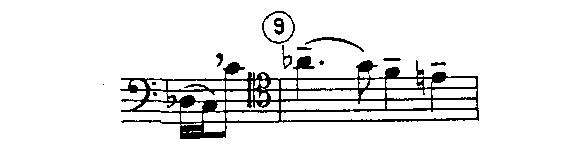
it was the left hand and the bow together -things like that which he showed me which were... The movement of the entire body creating this enormous drive. Those were wonderful things that he showed me. And also the relaxation in the left hand, the ability to do very beautiful, beautiful musical glissandi by relaxing the hand in between. Lovely things which have stayed with me. Casals couldn't express his musical ideas. He could show you, he could demonstrate. Feuermann could talk. Casals didn't talk. If you played a phrase for him he'd say "No, no. Not like that" and then he'd sit down at the cello and show you what he wanted. But Feuermann explained to a greater extent what he wanted.
Q: You were talking about relaxing in between the shifts...
A: For instance in the Polonaise [Chopin, Op.3] if you were doing [Plays the first two phrases (i.e. the first two cello entrances) in the Polonaise. Demonstrates a relaxed glissando from the top G of the first phrase down to the C, and then another in the second phrase from the D(edc#d) up to the F#]
Q: So it's letting up of...
A: Yes, letting all the tension out. Things like that can be so helpful in phrasing.
Q: It seems on the film that his left hand is very 'active', very tight in a way when it's moving...
A: No, I don't think it was much different than [Demonstrates playing all four fingers rapidly in a relaxed motion in scale passages] It's that ease of motion which he had which was so wonderful and my hand, I think, is very close. As a matter of fact, when I was in great shape, 6o years ago, they compared my playing at that time -in the Times- to Feuermann's because my left hand was very much like his.
Q: You have a little bit of angle [in your left hand], kind of like a violinists approach... [His left hand angles slightly back towards the pegs, as seen from straight on]
A: Yes. It's the ease of motion and never the extensions, just the movement of the body, moving with the hand, and also a little bit of the wrist for this [moves wrist so fingers strike string] -for the enunciation.
Q: Did he have the enunciation of every note, so that you can hear every finger on the fingerboard?
A: Yes he did. Casals even more than Feuermann. Every time he started it was [demonstrates finger hitting string]. That kind of thing. He wanted the beginning of every note. He wanted to hear it just like the piano. It had to be crisp -even in pianissimo.
Q: And I notice you do sometimes the plucking he talked about?
A: Yeah. [Demonstrates with the 'plucking'] That's the Feuermann left hand.
Q: It's always in this position. [Closed, angled slightly back]
A: And always with great simplicity and ease. It' s not a struggle.
Q: And it seems in control because it's not extending...
A: And also it helps for intonation, because your fingers find the right place if they're relaxed. If they're tense, you lose some of your sensitivity and the fact that your hand is relaxed also helps to play in tune.
Q: It's a relaxed hand but at the same time you have a hammering action from the fingers?
A: Oh yes, but that doesn't take strength. That's just a question of tendon striking, not muscle.
Q: Did he ever talk about exercises for trills?
A: No
Q: Or did he recommend any kind of exercises in general?
A: No. I studied only major pieces in the repertoire. I remember I did the Dvorak concerto with him, I did the Brahms F major sonata, I did the Locatelli sonata with him- these were the works that I had with him. I must say that I had to go into the service and that was he reason that I stopped working with him, but it was not enough for me. I felt that I would have loved to continue working with him. It wasn't as intensive a period of time as I had with Casals. It was the same period of time, but with Casals it was much more concentrated work. I was living in the village and working three times a week with him, and with Feuermann it was once every two weeks. I even remember a card he sent me because I was late arranging for a lesson. Two weeks went by and I hadn't gotten in touch with him and he wrote me a card and said "Was your last lesson the finish of your study with me?"...Made me sit up.
Q: In terms of bowing, was there anything you took from him?
A: It was very difficult to capture anything on his bowing because it was the most beautiful bow arm I've ever seen and, while I've tried to hold the bow the way he did, things didn't come out the same way.
Q: How did he hold the bow?
A: It was a very natural -it was a little bit more like a violin bow than a cello bow. He had a little bit of an angle to it, like this [Demonstrates. His hand is angled towards the tip. His second finger is placed near the metal band on the frog] with the little finger up on top of the bow. Casals position was this [Demonstrates. His hand is more squared (vertical), with his third finger on metal]. Rostropovich's is like this [Demonstrates. His wrist is lowered and his fingers are higher on frog. It looks 'grabbed'] ...
A: So that would explain why in the video, whereas most cellists have their third finger on the metal, he had his second finger near the metal.
A: Well it would pull down this one, yes. This was his position. But mine eventually was changed to this [indicates Casals type position] But his bow arm was as great as any violinists'. I think even greater than Heifetz. Incredible bow arm, he could do anything. You know that Toscanini had his eightieth birthday party and the NBC orchestra had arranged for a birthday party for him at one of the auditoriums and the orchestra came in short pants -with velvet pants, like prodigies. And Heifetz came and Feuermann came with his short velvet pants, and one of the things on the program was Feuermann playing the Mendelssohn violin concerto, the last movement with the cello [ed.-he means violin] between his legs. And it was a sensation, I mean the way he handled the bow, it was just incredible. He played a beautiful performance of the last movement of the violin concerto.
Q: Someone told me that if you watch Heifetz, you'll notice that he plays a lot in the upper half of the bow...and they were thinking that Feuermann was along the same lines.
A: I don't think so.
Q: One thing I did notice on the video is very conscientious usage of the bow in terms of spacing...
A: Yes. Well the tremendous control of the bow...
Q: About glissandi -you talked about the releasing in between [notes], the coordination...
A: And the use of speed of the bow also, in ...the Feuermann slide. It's [Demonstrates-the same passage as before in Schelomo] The use of the bow and the finger together. That punch that he had [In the demonstration, Mr. Greenhouse makes an accent with the bow, partly with bow speed, to coincide with the arrival of the left hand] Enormous projection with the use of the speed of the bow and the left hand.
Q: Did he talk about waiting before the shift?
A: Well there was always the [Demonstrates a small hesitation] There's that little wait before the -two hands work together. With my students, I always talk about that particular kind of glissando, which was enormously helpful in bringing out the climax ...
One comment that I think I would like to make. When I knew Feuermann, he was unique. He was absolutely unique. There was no one. I had heard Cassado and I had heard Garbousova at that time, they were contemporaries, and I had heard Mainardi and some of the French people -Maréchal, and that was an era. I don't think today that we would have been quite as astounded with his technique, because I think he was a forerunner of a new way, a possibilities of playing the instrument which has caught on. And now when I'm on the jury for competition, as happens very often, I find an enormous degree of expertise on the instrument which we never had in the days when I was a young student. This is all new. When I listen to a thirteen year old...Hanna Chang. When I listen to a little kid like that play with a technique which is incredible for that age, thirteen year old. We had nothing like that. We didn't have any Menuhins playing the cello at that time. We had Felix Salmond, who was a fine musician and a wonderful artist. Had a very beautiful sound, but couldn't play the cello as well as most cellists play today. Had difficulty with the instrument. And when Feuermann came along, we didn't even have a knowledge of Casals playing, because he hadn't come to the United States and I hadn't heard him in person as a youngster. ...I'm talking about those years from 1925 to 1935 when I started to become serious about the cello and there was no opportunity of hearing Casals. I heard only Willem Willeke and [Janos] Sholz and Alfred Wallenstein ...the first cellist of the Philharmonic. These were the cellists, and they were not great instrumentalists, none of them. And when Feuermann came along, it was a shock that the cello could be played the way it was, the way he played it. So he was the one who showed us what the horizons could be on the instrument. More so than Casals because, while everyone loved Casals playing in Europe -he was revered in Europe- in America he was not known. He had sparse audiences. He had 75 people in Philadelphia when he played at Orchestra Hall. So he was not the model. It was later, when Feuermann started building his reputation, and Piatigorsky also, that we began to discover what was possible on the cello. Feuermann more than Piatigorsky, but Piatigorsky also was wonderful artist, very sensitive, and so he made his mark in this country as well as Feuermann. There was great competition between the two.
Q: Did you ever have the chance to play to Piatigorsky?
A: Yes, I did...I always had a new Packard convertible, right up until the time I went into the Navy, and I used to drive him up to Tanglewood when he had a performance with Koussevitzky. I was the one to take him from New York to Tanglewood and always had a chance to play for him and lots of talk with him. I had a nice friendship with Piatigorsky, but no real study with him. He resented the fact that I was working with Feuermann. Said so too. They were not great friends.
Q: You talked about the general technical level having risen. What about stylistically?
A: Well there's been an enormous influence today with Rostropovich. He has become the major influence in the cello world today. Everyone wants to be either a Yo-Yo Ma or a Rostropovich, because naturally young people want success with their work and so they emulate the people who are successful. I think that they are both not quite in the Piatigorsky mold. I think that Yo-Yo would be closer to have followed in the footsteps of a Feuermann than Rostropovich. I don't know whether the principles of Feuermann have rubbed off on Yo-Yo. I would say that he has the advantage of being as natural a gift as Feuermann on the instrument. I don't think that there's anyone who's been able to communicate musically on the cello as well as Casals. There is no one today, and there is no one at the time when he was playing either, who came up to that standard of musicality and artistic height. I admire Yo-Yo's playing. I think he's a wonderful, probably an enormous gift on the cello in every respect and certainly Rostropovich is a genius in many respects. His knowledge of the instrument is formidable and his work with new compositions of great difficulty -being able to analyze and work on new pieces is spectacular. Nobody else has the same ability. But these are all different, various aspects of talent, and one has to pick in his own way what he's looking for. Some people will react to the playing of a great player like Fournier and another one to Tortellier or to Navarra. Each one has a stamp and I personally found my own horizon to be as close as I could get to the musical inspiration of Casals. With the help or the technique which I learned from Feuermann and the musicianship which I got from Felix Salmond. They were all helpful in building something which I eventually felt was my own way of playing the instrument. And I've used all of their ideas in order to make my life a beautiful one, doing what I wanted to do, which was for the main playing chamber music, interspersed with orchestra performances and solo recitals, but for the most part a diversified career which gave me the pleasure of making music. And using all of the ideas which I've gotten from many teachers.
Q: It seems a happy combination of teaching...
A: I think it's essential. I feel sorry for the young gifted people who stop studying too soon, because there's wisdom in age and there's guidance also from the older people. And just because you start on a career, of any kind, and you might be twenty five years old or twenty eight years old and you think 'Well it's time to stop studying now. It's up to me' No, but there's so much to be learned when you're thirty years old. And that's how old I was when I went to Casals. I was thirty and I still had the desire to learn from a great master. I wouldn't have gone to anybody else at that point, but I knew there was one man who could still lead the way for me to open up new vistas of musical ideas.
Q: That seems like a much healthier attitude than this attitude running rampant right now that if you're not touring the world by 18 [years old] you should be out of music.
A: It's almost sad to see the lack of development in the people who have great careers. They have great careers -they're playing all over the place with fantastic fees, and you hear them play and it's a little bit deteriorating from what you heard ten years earlier when they were just starting out. It doesn't improve, it gets worse as they go along. And I'm talking about string players now, with big reputations. And the mistake is that they stop studying, they say 'Well, I have everything that a musician could want. Why should I go study now?' The mistake is that they can never really achieve any great satisfaction for themselves because...learning is something that goes on your whole lifetime and if you don't continue and if you're not willing to subject yourself to teaching, at some point, you miss out on the great pleasure of making music, because even today -I don't want to play any more. I mean I can play, but I have stopped performing except for an occasional sonata which is not demanding, but I've stopped playing because I don't want to spoil anything that I've done in 50 years of a career and I don't trust, physically, I don't trust myself to do things on the same height as I used to. But I'm still learning. I'm still willing to try something new on the instrument. If I see a student who can do something that I can't do, I take it from him. And I'm not ashamed to. So it's this attitude which I feel so sad about when I hear great performers who not only stay on a level, but come down lower than their own standards, simply because they're not learning as they have their careers. I can bet that there are things which just in discussing with Yo-Yo, talking with Slava, who's a friend of mine, that would give them some ideas, and of course I could get some too. But the interchange of ideas at a high level is so important. That's why someone like [Louis] Claret, who is having a big career now in Europe, came for a week. I've had lots of people, like Frans Helmerson, people like that who I can talk music with and show them some of the ideas which have passed on through Feuermann, through Casals. Give them some ideas too of which way they want to go.
Mosa Havivi studied with Feuermann in Berlin from 1930-35, and continued a friendship with him for the remainder of his life.
(paraphrased from interview notes)
Mr. Havivi spoke of a 'rocking' motion when moving the left hand up or down the fingerboard. When going up the fingerboard, the left hand begins inclined towards the scroll of the cello and rotates forward as the distance is traveled ending with [what appears to be] a quick finish to the rocking motion -that is to say a large part of the 'rocking' is accomplished during the final stage of the position change yielding an attack from above. The procedure for going down the fingerboard is exactly the reverse-'rocking' backwards, as it were. He said that by utilizing this procedure Feuermann was able make distance traveled on the fingerboard irrelevant and was therefore unafraid of leaps of any distance.
Mr. Havivi spoke of Heifetz's use of the upper half of the bow, a region which he believes Heifetz utilized for his best playing. He stated that it was both easier to play slowly in the upper half -contrary to one's instinct- and easier to control fast speeds. He implied that Feuermann was aware of this, and like Heifetz utilized the upper half to great effect.
Havivi said that Feuermann believed that each finger had its own type (sound) of vibrato and sometimes choose fingerings based on the type of vibrato sound dictated by the music. He said that Feuermann frequently used different bowings and fingerings but produced the identical musical effect regardless. He related a story of Feuermann performing a fingering in the Haydn D major concerto that Havivi suggested to him during the dress rehearsal. Havivi also said that Feuermann made an effort to put changes of position on half steps. Speaking about thumb position, Havivi said that the thumb was always to place firm pressure on the string, and remain as such while the other fingers moved freely. He demonstrated a fingering taught by Feuermann in the Beethoven A major sonata which illustrates a usage of the thumb that is quite unusual:
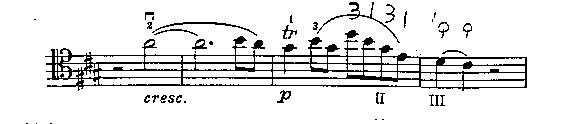
He said that Feuermann used this fingering in this instance because the diminuendo implied in the phrase allowed it.
Havivi talked of Feuermann's absolute coordination of the right and left hands and the clean style that resulted, saying that Feuermann never produced a glissando unless he choose to do so. Havivi believes that the right hand is much more difficult to master. Speaking of Feuermann's performing editions, he stated his belief that Feuermann choose for them easier bowings and fingerings than he might use in performance, for the sake of the students. Specifically, he discussed the A minor scale in the opening of the Schumann concerto which Havivi remembered Feuermann playing in one bow, but which is separated into two in his edition.
Talking about Feuermann's consistent choice of fingerings to conform to the dictates of the musical line, he compared his fingering for the opening of the Boccherini A major sonata to that in the Stutschewsky and Piatti-Forino editions. While Feuermann plays 1-2(4212)-4-2, the other editions choose 1-2(4212)-1-2 resulting in an unmusical accent on the G#. Feuermann's shift is on a half step and on a major beat, avoiding an accent on the musically weak G# 16th note:
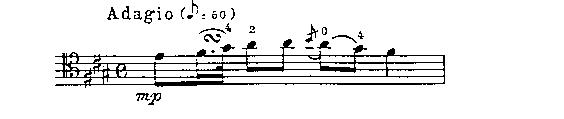
Havivi believes that pure technique should be learned by playing Bach and reminisced on Feuermann's performances of the G Major suite, the prelude of which he said Feuermann played non-legato so as to deliberately distinguish his performance from Casals, and the C Major suite, which he said Feuermann played in fast tempo but beautifully sustained much, he said, in the same manner as his recording of the Reger suite.
Asked to speak about the differences in contemporary cello playing compared to Feuermann's, Mr. Havivi spoke of the impact of steel strings [Feuermann used a steel A string when it became available, but his lower strings remained gut] and the impossibility of obtaining quality gut strings today. He correlated this with the modern obsession with producing a gigantic sound. He also spoke of musicians not understanding how to produce what the music dictates. He gave the example of an actor speaking the phrase " I want to go with you". Depending on whether the emphasis is placed on "I", "want", "go" or "you", the meaning of the utterance changes drastically. It is the same in music, and musicians ought to be aware of the same musical 'grammar' when creating a phrase, he argued.
Speaking about Feuermann as a teacher, Mr. Havivi said that Feuermann had a 'god given' technique and that he didn't tell his students how to correct their flaws. That, Havivi said, you had to learn for yourself. Feuermann would say only "Can't you hear that you lose that note?", or "...that you accent that note?" or whatever the complaint was.
Asked about Feuermann's apparent favoring of the 1st, 2nd and 3rd fingers and less frequent usage of the 4th finger in fingering, as observed in his film, Havivi said that Feuermann learned from violin technique. In comparison to other cellists who believed in extending a whole step between each of the four fingers, Feuermann understood that the second and third finger were connected, he said. He also discussed Feuermann's practice of extending the third finger straight while trilling between the second and fourth fingers, which he said relaxed the hand.
Mr. Havivi composed a set of Seven Caprices, published by Carl Fischer in 1939, which are designed to develop the cellist's technique in accordance with technical principles discussed here.
Q: When did you first study with Feuermann?
A: 1942.
Q: And you first met him?
A: I met him when I was on tour with Leopold Stokowski with the All American Youth Orchestra...In that orchestra was a cellist ...[Irving] Klein, and Klein was a student of Feuermann and he was dying to bring me to play for him, so when we got to Los Angeles...that was when I went up to Feuermann's home and played for him, and then I decided I wanted to come and study with him. So when I got back to... Toronto, I commuted to New York for the lessons with him. But I didn't have so many. I was with him maybe five weeks, that's all. And then he died...I can't even tell you how we got along, because there was no problem and I used to hear that he was miserable to all of his students -absolutely awful- but ...George Neikrug said that he never -when I came for my lessons- did he ever say anything that was nasty. He was not nasty to me at all.
Q: David Soyer told me also that Feuermann was very fond of you...
A: I wouldn't know that. But it was wonderful to play for him. I didn't have that much time, but the real impression came after his death, with the remembering of his playing and the few records that he left, and everything about his way of execution was so effortless. Not that I had any problems with technique, but I do remember a wonderful...incident when I was playing -I've forgotten where it was- when a man came backstage and introduced himself. He said "You don't know me, but I was a very close friend of Feuermann" and said "I got a letter from Feuermann in which he said 'Today I heard a young Canadian girl who plays better than I do.' " Can you imagine being told that from somebody who died years and years and years ago? That really did have a tremendous effect on me. But, you know, he didn't say anything to me about my playing. They never do. Neither did Casals...There is something about teachers when they do have a talent -they are so honest and interested in what that student does, and what they're going to do with their future, that it's automatically taken for granted that the student knows how the teacher feels about them. But I realize it' s not so and I do think a teacher should never hold back, and I do feel it's wrong not to tell a player how you really feel about their playing because everybody needs that. Not false praise but honest opinion, which is what we're looking for...
Q: What would you say you got [from Feuermann] in terms of approaching the instrument?
A: As I said, very little -while I was with him. I think the only work we had time to work on was the Rococo Variations. And that I played when I was thirteen already. He was -I remember one of the things he stressed very much was the perfect coordination of the bow and the left hand when you go to take a glissando, and if you listen to some of his records, a lot of his glissandi have that perfect coordinated sound of the bow and the left hand, but one doesn't always want to make that kind of a glissando. There are many different kinds of glissando. But he didn't have too many. But it was his effortless way of playing...but it was effortless playing which made great sense. I mean you can't get carried away because somebody plays effortlessly, but it's what they do with it, and it was what he did with it that was so wonderful, even with the few recordings that we have left. But he had great purity of sound, which was wonderful. It was a very special sound. As I say, I only heard him once in public.
Q: [Are there] any specific types of things that you remember him criticizing in the lessons?
A: That's the only thing I can remember in my case. I sat in on one or two of his lessons but I can't remember what he told them except that he was always bawling them out...
Q: Did he talk ever about things to practice -scales, anything like that?
A: No. Not with me, no. Those that came to him, I think, had a pretty well established technique. Otherwise I don't think he would have bothered with them. I remember he was moving into his new house, which was not yet ready, in Scarsdale, and the lessons took place once at the home of one of his students, here in... Manhattan and I can't remember the name of one of his students, who lived at home, and so he would come in from Scarsdale or once we went out there...
Q: After he died, you said you found influence in his playing?
A: Well, after he died, I listened a lot to his recordings and remembered the one and only time I heard him play in public, and that was when I really began to understand his way of playing.
Q: Did he have a big sound?
A: He had a big enough sound. I heard him at Town Hall. That was where he did the Mozart [trans. Szell] concerto.
Q: How would you compare Feuermann's approach to the instrument with Casals?
A: You can't compare. It's impossible... Casals was something in his own class. You couldn't compare anybody to him. Feuermann had yet to arrive at that stage... They all tried to get to him... Cassado when he was a young man came close, but later it was not the same thing. Cassado was the only real student that Casals had...the others spent time with him, but it was really Cassado that you can really say was his real student, and [also] probably Suggia, who studied with him when she was very young. You can't compare anybody that I know with Casals. I don't speak about his recordings that he left, because they are not Casals at his best. They're very much exaggerated in many instances because he was a very nervous recording artist...His way of overcoming his nerves was to exaggerate sometimes and you can hear that in some of his recordings. But I worked with him and I know how he plays. ...When I first went to study with him and I took the Bach suites and I listened to the sixth Bach suite and copied every single little thing that I could hear. And then when I went to study with him for the first time in Prades, and the last lesson was the sixth suite and I played it for him -he nearly threw me out. He said "Why do you do this?" and "Why do you do that?" and I didn't want to say 'Because you do it on your record.' And then he sat down and played it for me. It was completely different. So I know the way he plays...
Q: How would you describe his playing?
A: It was as close to pure music as you can ever get. His playing was reaching into what the composer was trying to say first. Not, as one hears so often today, the opposite way -doing something because you're not sure of what to do musically. That wasn't his way and that's what made him a very, very great artist. He had a magnificent sound. It was not what I would call an earthy sound, but a very pure sound and expressed his musical ideas like no one I ever heard.
Q: Did you work with Piatigorsky?
A: Yes, for about three summers.
Q: What about Feuermann's approach to the instrument versus Piatigorsky's?
A: Piatigorsky did not have the natural technique. He got around, and when he was much younger he got around extremely well, but as he grew older he stopped being as careful or caring as much. Music probably didn't mean as much to him as it did to Casals. Or to Feuermann. So you find a lot of his early playing was full of 'little tricks'. But I don't like to say that because he was really a great artist. But I think of him in the beginning, because I heard him when he first came out of Germany, in London and -one of his early performances- and he walked on and played Dvorak and Don Quixote in one evening. It was magnificent. And then I would go and hear him every time he came to play in London until I left. Then he moved to this country...There really are no artists that I would put in their category. There is one and he is about the closest I think to what I feel is great playing...Miklos Perenyi. He's a lovely artist, but you know this country is not interested in anybody else except Yo-Yo. I mean I'm very fond of Yo-Yo, but that's a different planet.
Q: What do you think is different in the modern style of playing -in general?
A: It's like a beautiful Iris that has a different color put over it and you call it an Iris. It's not real. And the unfortunate part is that a tiny percentage of an audience that goes to a performance today knows any different...and the managements. Forget about them. They really don't know anything, and if you're over the age of about fourteen you're over the hill.
(Paraphrased from notes taken during conversation)
American cellist David Soyer studied with Feuermann during the year prior to his Feuermann's death (1941).
Mr. Soyer discussed an instance when he, being too young to know any better, asked Feuermann "Why do you slide so much?" Feuermann responded that "The cello is not a clarinet. You don't just cover the holes with your fingers" and explained to him his philosophy that cello playing should have a fluidity much the same as the human voice, and that the glissandi he employed helped to make it sound so. Mr. Soyer said that Feuermann held the opinion of the cellist Diran Alexanian, whom Soyer classified as a disciple of Casals, in high regard and frequently consulted with him. Soyer states that Alexanian particularly emphasized articulation. Mr. Soyer also stated that he believed Feuermann's bow arm technique was related more to that of violinists more than to traditional cello technique.
As at teacher, Mr. Soyer found Feuermann harsh and demanding, not beyond hitting the student with his bow or breaking out into peals of laughter at their attempts. He believes, however, that Feuermann's playing represents the most highly developed style of cello playing to date and considers him to be more 'modern' than contemporary players. Mr. Soyer identified Alexanian, Casals, Feuermann and Janigro as practitioners of a 'modern' style of cello playing, while the schools of Leonard Rose and Orlando Cole were named as examples, among many, of a contemporary style which Soyer considers to have returned to pre-Casals practices.
In The Strad [1], Mr. Soyer is also quoted, from an interview by John Samuels, as saying "Feuermann was a happy combination of much good schooling. He was a pupil of Julius Klengel...and also had the schooling of Diran Alexanian and hence that of Casals. The result was a very highly developed way of playing the cello; very efficient and amazingly accurate and facile. At the same time his playing had a tremendous elegance. Rudolf Serkin once said 'Feuermann had a great deal of Viennese charm in his playing.' "
___________________
1 “As They Knew Him” The Strad, 99 (April 1988): 315
Sophie Feuermann, the youngest of the Feuermann children, became an accomplished pianist. She began performing with her brother in 1927, and continued to collaborate with him through 1938.
[Prior to the tape recorder being turned on, Ms. Feuermann explained that the name 'Munio' was a version of Mendel, which was Feuermann's birth name, honoring his recently deceased maternal grandfather. She said that the name Emanuel was suggested as a stage name by an agent, who thought that it created the correct association for a prodigy, when he first began playing before the public ]
SF: Wherever I give speeches...I always start with explaining 'Munio'. Because Munio is not a pet name. In our background, there was no room for pet names, you know, we just were improving. Our whole background is improving, which is very important.
...I can't stand biographies. Everything turns out always wrong. I don't know why. For instance... Munio started cello when he was seven years old. Two years later, nine years old, he gave his first concert, the debut, and the next day -morning, people came -I mean very important people found out where my parents lived and wanted to meet the wonder. And that is very interesting because he played football, and so my mother sent my oldest sister to football place and get him back. He didn't come. He wants to play football, which is wonderful, because we were absolutely never brought up as something special. And that trait you hear in our playing, you know what I mean? This clear way, and not fuss and just the music and musicianship, you know? This is the way. But what is on the tapes? [Referring to a radio documentary] That his debut was 14 years old with the Philharmonic in Vienna.
Q: How would you say that your musical thought, and his musical thought -your way of approaching pieces -is different from the way people approach pieces now?
A: If you read my script [Referring to a script for an educational video tape which has not as yet been produced, entitled "Conversations with Sophie Feuermann on Musicianship and Artistry"] you have all the answers, but I can tell you just basically what I call- you have to live in the skin of the composer, and the difference between my time and today is when you hear today, everything sounds alike because it just -Mozart's father, Leopold, 250 years ago- I read only these originals. You see these? These are in own words. Beethoven, Mozart...-said that "Teachers are the worst because they don't think that one should learn, they only think of themselves, and they don't teach anything." You see, when I start, when I did teach beginners, I never had trouble -from scratch. It's like upbringing of children. You can not really tell the children what to do, but you give them the basis, the value, and then they have to do with it whatever they do -it's their development. And this is what is entirely lost, in everything -everything, you see? And look at the culture. Look at the youngsters, how they look. Look how dirty they look, how torn pants, everything, you see? The same thing is in music. I turned on -it was in my speech actually- I turned on by chance -I'm not a television person- however, I turned on the educational [channel] 13, you see, and here was a replay of Rubinstein and Isaac Stern gave a master class in Jerusalem, and as I turned on the television he was sitting there on the left side and the young girl -she must have played, which I didn't hear- and I hear him say (you know many pupils and friends called me afterwards, after this) [he] said "I don't know what has been going on for the last 50-60 years" -he was already very old. He said "When I went at my age, when I was young, we made music. We played because we loved it, in music. Today, it's only fast" And this is the answer to your question, you know what I mean? Then comes Isaac Stern, and a young violinist stands up and starts a Bach Partita, and after a few bars -the way I do it, you see- he stops him and he says "I don't know what has been going on for many, many years"- he wasn't that old yet. So he said "I have the feeling what the violinists -the instrumentalists- cannot get out of the instrument, they want to get out of their body. That's why they move around." And I added to it 'I pity them when there's a double mordent!' You know with their neck, you understand? It is disgusting. I cannot go to concert anymore, nothing. And this is the difference, that they don't live in the skin of the composer. Each composer is a different individual, and not every artist should play every composer. When Horowitz plays Mozart or Schubert it's a disaster, you know? But there will be one Horowitz in this -you know, and he plays other things, you know what I mean? And this is very important. This is the answer to this. And when you live in the skin of the composer, where does it start? With your eyes. And you see from the eyes, you have to see what the composer writes, and from the eyes it goes into the head, and from the head it goes into the heart, and from the heart -Rubinstein said the same thing- from the heart it goes into the arm and the main thing are the tips, you know what I mean? And that creates out of reading, musicianship. Then you develop artistry, and there are maybe a handful of artists in the whole world, but you have to live in the skin of the composer.
Q: I also read what he [Feuermann] was saying, talking about the first approach to a piece being to analyze it by sight... and understand it. So when you would come to rehearse together, how would you approach it?
A: We rehearsed very little. You know, I remember, because it's the same approach. I remember in big cities...we had a big concert in Vienna, and it was on a Monday -I remember like today- and he sent me one week before, on Monday, the whole music and ... was the first performance of the Stravinsky, the Italian Suite...Then he arrived Sunday evening, before Monday, the concert. And as we are sitting having dinner -I was married and he stayed in my house- so he turns to me -you know I'm the kid sister and we had a special relationship which Eva's mother and everyone was so jealous. They all had one thing in mind. To break it, because they were jealous. You have no idea about my suffering. And Munio's suffering. He would never have died if I had been there. Never. So he says to me "Now what about tempos?" The Suite -the other things I knew...Beethoven and Chopin sonata, everything. So I said "I'll tell you something. I sped it up to the metronome numbers, so you have freedom. You do what you want." Oh , he was delighted. And then it got to be the next day of the concert around five o'clock. He said "I'm tired. No more" So I said ''but what about the encores?" and he said "You will do it." So when we -there were of course terrific applause, etc and -you know my reviews were very often much better than his, even, but I don't...there is no one like Munio, this cellist, you see. But as we walked on the stage to bow and he had some music in his hand, so I say "What is it?" So, I'm not sure -I have a feeling it must have been the [Faure] Apres un Reve, because all he gave -I said "Give me the tempo!"- so on the door... he knocked like this. "This is the tempo." And it went off wonderful, because we had...we understood in the musical level. But the main thing is that you have to live in the skin of the composer and not play each composer the same way. Because then you play only yourself, you don't play the composer.
...[speaking about Feuermann's teaching] he was by nature a phenomenal teacher, by nature. It's always in our house, improvement, improvement. Not correcting, but improvement, and that is very important, because it doesn't hurt the student. When you say you have to improve, it's different from when you just hit him. You get the difference? He was a very, very, very all round wonderful person.
Q: Compared to people in his time, what was the difference?
A: I mean the cello had not developed that much yet. Casals was the first one, and he [Feuermann], when he was 16 years old, he became professor in Cologne and the Gürzenich Orchestra, he became the first in, and the Gürzenich conservatory. And he walked into the office. The secretary-[Feuermann was] 16 years old- said "Get out of here! We're expecting Professor Feuermann." But of course at that time, he didn't what you call teach the way he taught later. Nothing wrong that he did, but it was not that strength -inner strength. If you want to know that he studied for two years in Leipzig with Klengel. When he left Vienna, there came people to wish him well, you know the Feuermann family, so one of the old ladies that came said to him "You know Munio, when you come back, I hope you will be a second Casals." He said, "Oh no. I want to be a first Feuermann." You know, not copying, not imitating others. Has to come from you yourself. With the basis that I explained to you, and this is decisive.
Q: Is there anything you noticed technically..
A: Havivi has his playing...Havivi is the one who has his tone, who has his really mental level, everything. Marion Davis had exactly the same kind...You know what the trick of Munio's -not trick, but the control, how he never -he practiced only the two years in Leipzig. He learned in one week all six partitas [Bach Suites] by heart. That's when he studied and when he played you never hear ...a change of bow. Never. And everyone says, of course, he is. I respect Casals, but he doesn't want to be- first of all, he say...It is a different world. But he only practiced, when we played together in the artist room, only the beginning of the A major-legato [Sings the opening notes of the Beethoven sonata, Op.69] You see? That was the only thing I heard him always play in the artists' room. And then he had an exercise...You see, his control was only came from the index finger. When I got married, my husband was play the piano very well. However, when people came, we play chamber music they wanted to play with me. And that's not good in an -especially- young marriage, you know what I mean? So I really suggested, and he did it, and he was very intelligent and so and he switched to cello -started cello. When Munio came to Vienna, and stayed in my house he studied for two months -had studied. So I felt it's good to switch to cello because you can play Haydn trios -bim, bom, boom- you know what I mean, and so on and so forth. Munio gave my husband his bow that disappeared. If I had that bow, you know, which was, where you hold it, completely bent, like this [indicates the area on the stick of the bow where the index finger would rest] from his control of the index finger...That is the way he controlled the change of bow. And this bow proves what I am saying. His control was completely in the index finger, and when we were in the artists' room, all he did is the one exercise, and I show it to violins, I show it to cellists, to everything. You see you hold the bow and [sings the beginning of a note] relax. Hold the bow, go back. But not pushing. Just starting, you know? Relax. and have the control completely here... Not like this. You play like this never...There's no control, you see. One hears every change and everything is the same. but never like this, you see? That what we called in out family...'watscheln' is like a dog that watschels. And that's what we call when came home and, for instance, my father asked "How was it?" "Oh he watscheld." Then we knew what it meant. You see you don't play like this. Don't do that, please, don't do that. I know it's wrong. Because a legato can not be if you don't control by playing like this. Munio changed this playing 150 percent. This is when you say before Munio and then when Munio played, changed the cello playing, the bowing completely.
Q: Except that it sometimes seems that nobody pays attention to what he did...
A: See that's terrible. Terrible. That was, before Munio's time, we know there was a very good -it was the Rose quartet- and there was the cellist, he was a nice and good...and all, you see, but he played like this. This is not controlled. I teach on the piano the same thing. You see you have to control Then I tell you another trick -secret of Munio's. Trill-you know the trill, when you listen to his trills, you see when it is -you know how. I do the same thing on the piano always, this is why we could play hardly rehearsing. When a trill comes, he puts his hand underneath the neck so that the fingers have the same distance control, and not like this and not like this...but not stiff, that you control...but the trill, and this is when you control it...not to trill like this [demonstrates the traditional type trill where the lower finger stay fixed and the higher finger oscillates up and down], but to trill like this, that the distance of both fingers, whatever finger you take, is the same to the piano, you know? ...
[SF:] ...the main thing is if you look at it, that you see what the composer wants. I do always, I tell pupils when they go home on the bus "look at the music and hear it." I know once in my young years I studied a fugue, and at I night I woke up -I could not see one bar. And in the morning, when I went to the piano, that bar I didn't know. You know what I mean? You have to really see it. So, what happened was, Munio was supposed to play, to give a concert in Mainz, Germany, and when he arrived at the railroad station at that time, he collapsed an had a sciatica attack. So he had no concert. He had to go to the hospital and stay, lie in bed absolutely flat, not moving three weeks. No wait -what comes you will be surprised, because it's based on looking. So, then told me all this, I mean I happened to be in Cologne, which is on the way. He had to play a first performance in three weeks, just -and he had to stay in bed- but in three weeks, in Paris. On his way to Paris, he had to change the train in Cologne, so I went to the railroad station and he said to me "You know, Sophie, I haven't touched that concerto, not once. I only learned it lying down."
Q: Which concerto?
A: Oh no -I don't know. It was awful...so he said "I only learned it lying down and looking at it. Learned it, but that my fingers have not touched one tone on the cello" On his way back, I saw him again, and he said "You know what happened? I played it. The next day. And the composer came in-now listen to that stupy -came in and embraced me" he said, "and said 'Feuermann, this is the way I dreamt it should be played, should sound.'" And Munio, in his honesty -he was very straight, the way we are. Straight, that you hear in his playing. Very straight- said "And you know, that was the first time I played it on the cello. I only learned it lying down." That composer was hurt...and that was the end of the friendship...The main thing is that you see and look. Musicianship starts with the eyes. And you have to hear it. That's training. I train them from the beginning like this.
Q: I guess it's a tendency nowadays, when someone sees something, the first thing they do is try to put the bow on the strings...
A: I mean there's no comparison, the way they study today, because the playing is...they play better, I mean purely everything faster. I mean the technique is perfect, but technique is like accomplishment, but it is not musicianship. I'm not out for accomplishment only. And that's it.
Q: But Feuermann's tempos were fast...
A: Not fast. You have to give time. Have you the Don Quixote?...I like the Toscanini better. Some people like the Ormandy better. I like the Toscanini. I think this is really unique. I don't think that he played ever what you call faster. It wasn't his nature.
Q: Somehow it's more fluid...
A: It's more organic. Call it organic. You see, that's the legato. It goes from one into -you know what Michelangelo said? The same thing that has to do with artistry, you see, musicianship. "When a sculpture rolls down a rock, and a piece falls off, that piece was too much." And that is artistry. It has to be rounded out. This is like modern music. I listen to everything, but it'll never succeed because there is no rounded out beginning and endings that closes. Nothing. It's one next to -twelve tone music is one next to the other, but not into the other. Isn't that interesting? To me it's fascinating...Absolutely different approach -it doesn't come from scratch. It's like upbringing of children...
...And Starker just runs on the cello, but he respected Munio. He said he was the king of the cellists. And who knows how Munio would have developed, what he would have done, because he was a brilliant man and very much for learning, you know, improvement. That's our background, improvement. Maybe it has to do with ghetto, you know? Whatever it has to do with, it's right.
Q: Everyone says 'No one will ever play like that again' but it seems that nobody tries to...
A: To find out. I'm trying to tell you -and read my script too, and try to follow it. Of course it's a question a talent. You can not learn talent, but you can improve immensely.
Q: I read in what he wrote, where he said that he thinks it's as easy to play well as it is to play badly...
A: Yes, I mean in an exaggerated way. It's like it's just as easy not to be a murderer than to be a murderer. You know it is the same. You have to know, and when I teach it's the same thing. I compare every thing with life. When you make a crescendo -who is the best one? The best conductor ever was Furtwängler. And Munio and I, we were just excited when we hear Furtwängler. We learned most from him. When you make a crescendo, what it is tragedy today people do it, they start already loud. But the end, that's -the end is the very thing. When you make a diminuendo -I fight it like anything, because it's wrong- they start already soft. But you have to know how many bars to you have to get there, you follow? They take everything much too superficially.